
Mold and Mycotoxins: Why Mold Produces Them, and How Bleach and Do-It-Yourself Cleaning Can Make It Worse
By Bayron Alvarez, NYS Licensed Mold Assessor (#25-671AE-SHMO) and NYS Licensed Home Inspector (#16000145204) — Casablanca Environmental & Building Diagnostics, Southampton, NY
When homeowners in the Hamptons and on the East End find mold, the first instinct is usually to spray it with bleach and scrub it off. That feels like progress. The mold changes color, the stain fades, and the smell of chlorine replaces the musty one. What it does not do is remove the mold, and what it can do is spread it. Mold growth releases more than spores. Some molds produce mycotoxins, chemical compounds that stay in the growth, the spores, the microscopic fragments of the mold, and the dust around it, whether the mold is alive or dead. This post explains what mycotoxins are, why molds make them, how bleach and do-it-yourself cleaning can make the exposure worse, and what removes the problem instead.
Summary
Mycotoxins are secondary metabolites some molds produce in response to their environment: competition, the material they grow on, moisture, temperature, and stress. They are not a gas; they travel on spores, on microscopic mold fragments, and on dust, and they stay in the growth after the mold is dead. Scrubbing, scraping, and sanding release fragments that laboratory research found in numbers up to 320 times higher than spores, and mycotoxins have been found on those fragments. Bleach does not reach growth inside drywall, wood, or insulation, adds water to it, and leaves dead mold that still has to be removed. Laboratory and agricultural research links oxidative stress to higher mycotoxin production in some molds; whether household bleach does this indoors has not been measured. What works is fixing the moisture, containing the area, removing what cannot be cleaned, HEPA-vacuuming and damp-wiping the rest, drying, and verifying, under a licensed assessor's plan for any contractor job over 10 square feet.
What mycotoxins are, and what they are not
Mycotoxins are secondary metabolites: compounds a mold produces that it does not need for basic growth. The best-studied come from Fusarium, Aspergillus, and Penicillium. Indoors, Stachybotrys chartarum is known for its trichothecene mycotoxins. Not every mold produces them, not every strain of a toxin-producing species does, and the same strain produces different amounts under different conditions.
Three points about how exposure happens indoors:
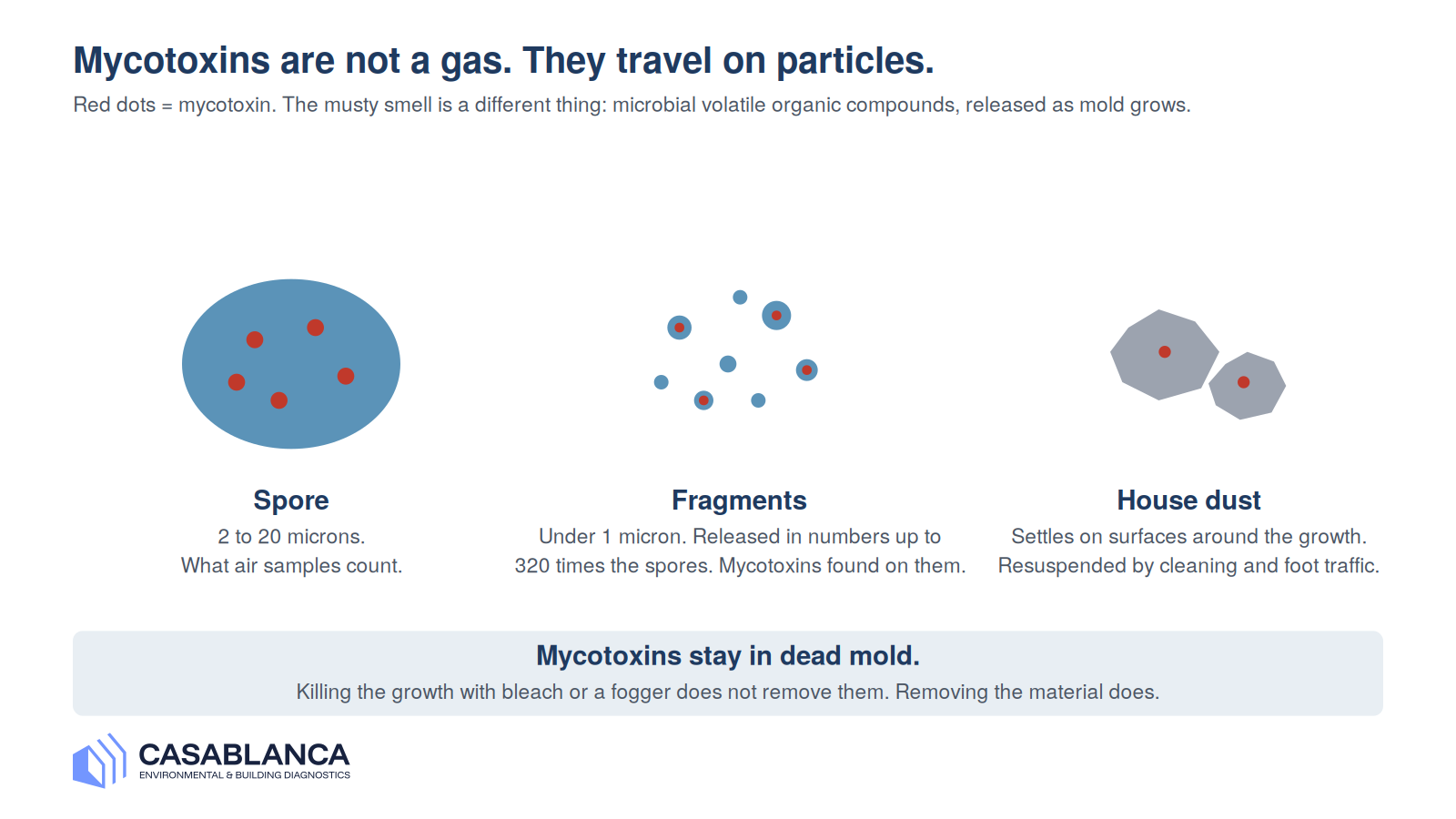
Mycotoxins are not a gas. They do not evaporate off the growth. The musty smell is a different set of chemicals, microbial volatile organic compounds, released as mold grows.
They travel on particles. Mycotoxins are carried on spores, on fragments of the mold, and on the dust that collects around growth. Research on Stachybotrys found its trichothecene mycotoxins airborne on particles smaller than spores, including mold fragments.
They do not die with the mold. A mycotoxin is a chemical, not an organism. Killing the mold does not remove the toxin already in the growth.
The health effects of indoor mycotoxin exposure are still being studied, and CDC's guidance is that molds that may produce mycotoxins should be treated the same as other common molds for removal. The practical point does not depend on that debate: the goal is to remove the growth and the material it is on, without spreading the particles that carry it.
Why molds produce mycotoxins
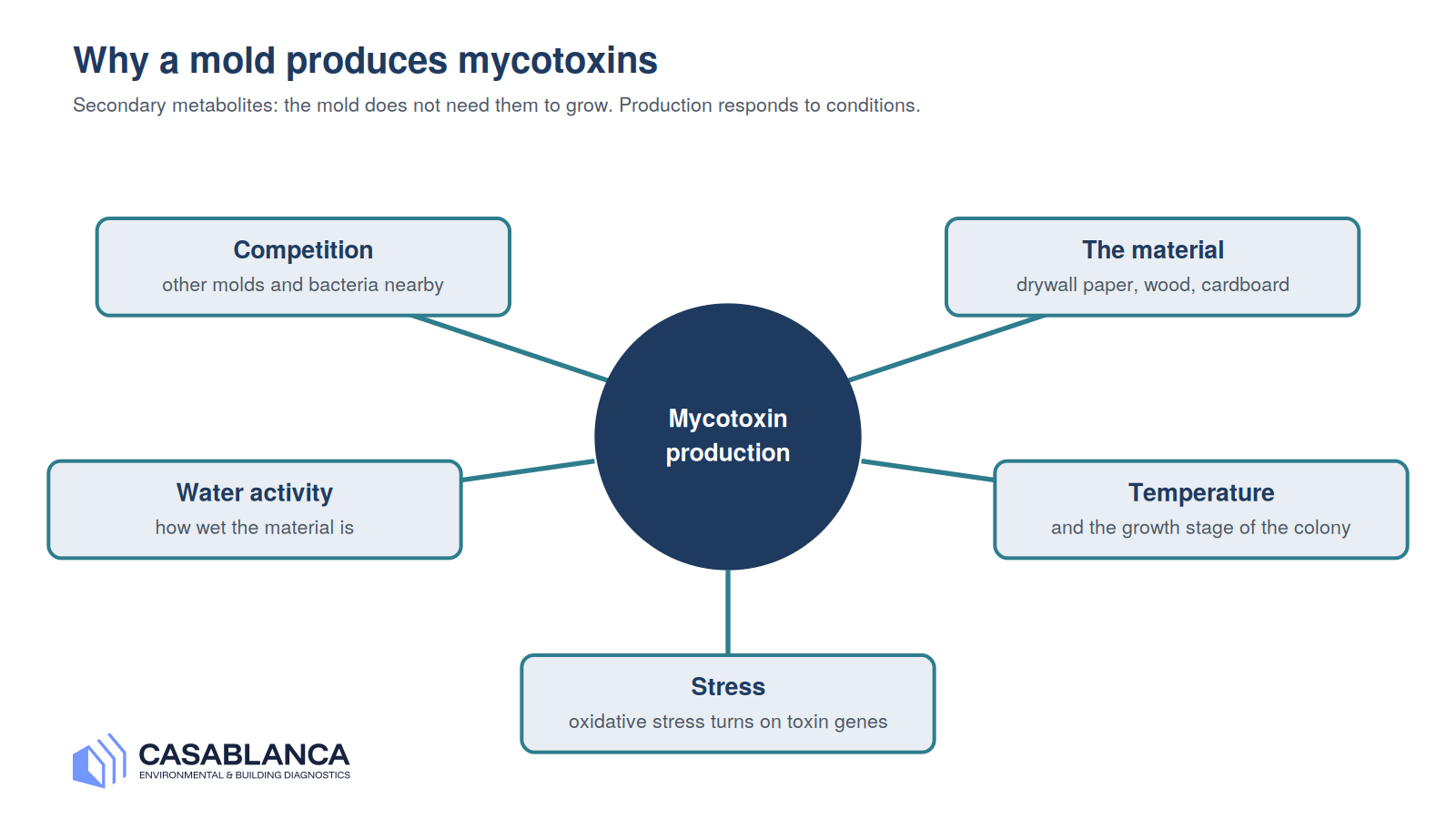
Researchers describe mycotoxin production as part of a mold's response to its environment. A 2010 review in Applied Microbiology and Biotechnology notes that when a fungus receives an external stimulus, it activates a signal cascade that changes how it lives, switching on the genes that make these toxins. Some mycotoxins help a fungus compete with other organisms. The factors that influence how much a mold produces include:
Competition with bacteria and other molds on the same material.
The material itself: what nutrients it offers. Cellulose materials such as drywall paper and wood support Stachybotrys.
Water activity and temperature, which affect which molds grow and how they behave.
Stress. The same review proposes an "oxidative stress theory" of mycotoxin biosynthesis: the pathways for several mycotoxins appear to respond to reactive oxygen species, the chemically aggressive oxygen compounds that build up when a cell is under attack.
That last point matters for what happens when someone sprays mold with an oxidizer.
How bleach and do-it-yourself cleaning can make it worse
Scrubbing, scraping, and sanding release particles. A study of moldy ceiling tile and other surfaces found that mold releases fragments along with its spores, and that the fragments were released in numbers up to 320 times higher than the spores. A later field study in moldy houses found fragment concentrations that may be even higher than the laboratory estimates. Those fragments are small enough to stay airborne and to reach deep into the lungs, and they can carry mycotoxins. Dry-brushing a moldy wall, scraping a basement joist, or sanding a stained subfloor without containment pushes them into the air of the house.
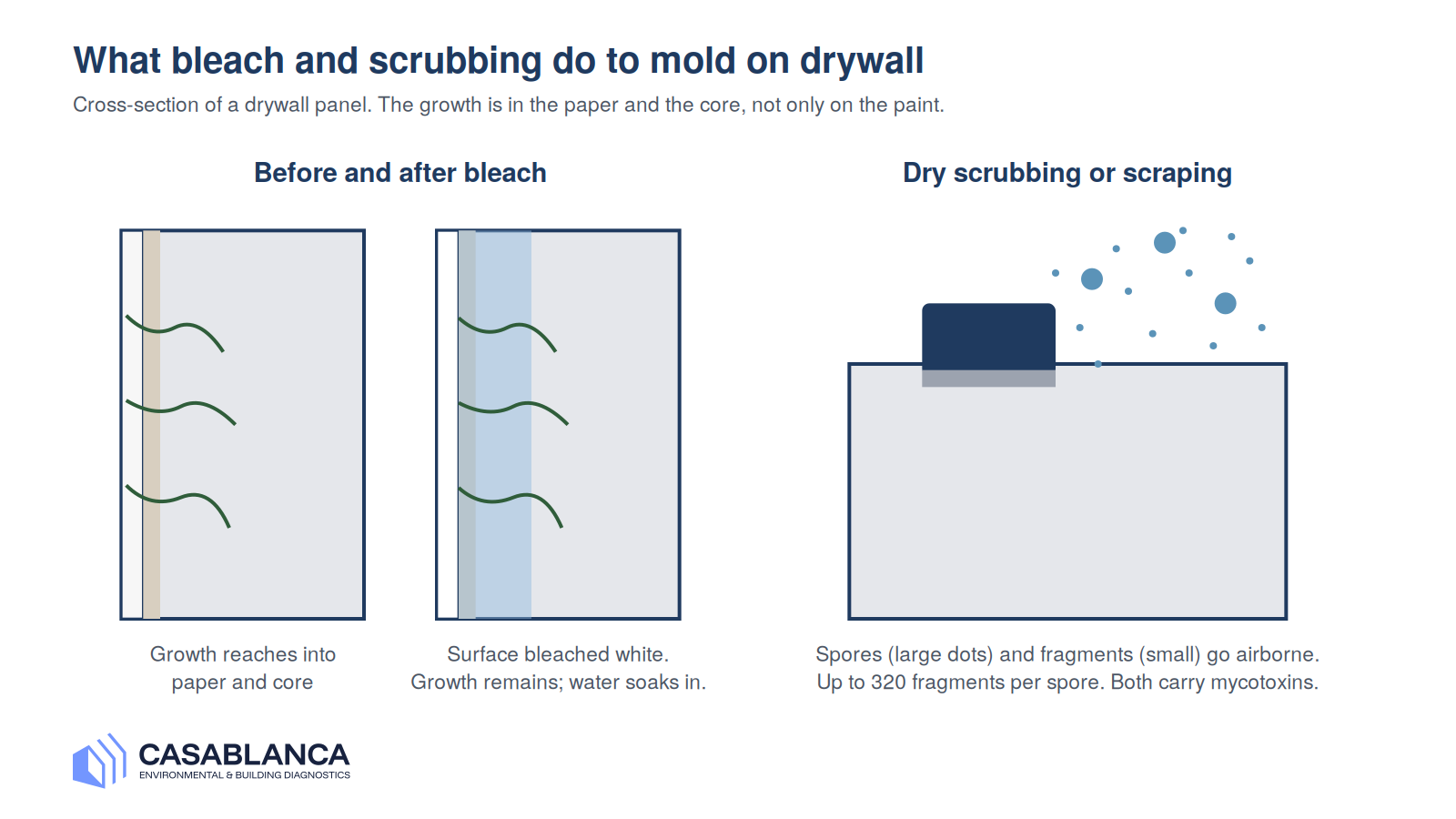
Bleach does not reach the growth inside porous materials. On drywall, wood, and insulation, mold grows into the material. Bleach changes the color of what is on the surface; the growth below it remains, and the water in the solution soaks into the material it is sitting on. Our post on why bleach does not fix mold on drywall or framing covers this in detail.
Dead mold is still a problem. EPA's position is that bleach and other biocides are not recommended as a routine practice during mold cleanup, and it adds a note: dead mold may still cause allergic reactions in some people, so it is not enough to kill the mold; it must be removed. The same is true of mycotoxins: they remain in the dead growth and on its particles.
Stress may increase toxin production. This is an area of active research, not settled indoor science. In the laboratory, hydrogen peroxide has increased aflatoxin production by Aspergillus flavus and deoxynivalenol by Fusarium, and agricultural research found that a sublethal dose of a fungicide triggered mycotoxin production through hydrogen peroxide in Fusarium graminearum. Bleach is an oxidizer. No study we know of has measured whether spraying household bleach on indoor mold increases its mycotoxin output. What the research does show is that a dose that stresses a mold without removing it is not a neutral act.
Mixing cleaners creates a new hazard. EPA's guidance is to never mix chlorine bleach with cleaners that contain ammonia, because toxic fumes can result, and to ventilate and exhaust to the outdoors if any disinfectant is used. A small, closed basement is the worst place to get this wrong.
What works instead
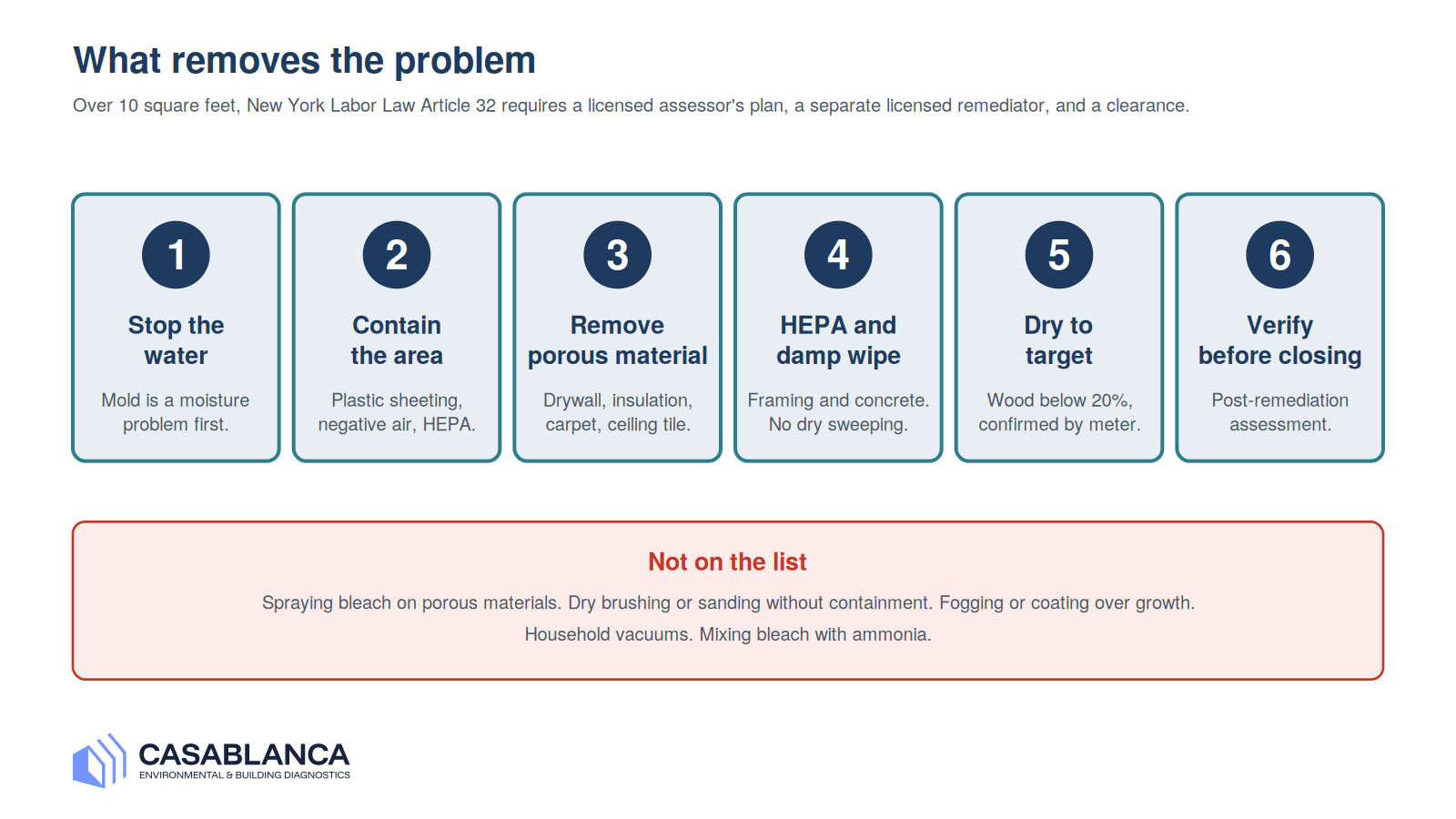
Find and stop the water. Mold is a moisture problem. Removal without fixing the source has to be repeated.
Contain the area with plastic sheeting before disturbing anything larger than a small patch, and keep air moving from the clean side toward the work, through HEPA filtration.
Remove what cannot be cleaned. Moldy drywall, insulation, carpet, and ceiling tile are cut out, bagged inside the containment, and taken out. Hard materials like framing and concrete are cleaned with HEPA vacuuming and damp wiping with detergent.
Do not dry-sweep or use a household vacuum. Both put fine particles back in the air. A HEPA vacuum captures them.
Dry everything to target before closing anything up.
Verify. A post-remediation assessment confirms the area is clean before rebuilding.
For a contractor's job over 10 square feet, New York Labor Law Article 32 requires this sequence: a licensed assessor's written plan, a separately licensed remediation contractor, and a post-remediation clearance.
What we do
We perform mold assessments, indoor air quality assessments, and post-remediation verifications in the Hamptons and across the East End. We find the moisture source, map where the growth is, and write the remediation plan the contractor follows, including containment and what has to be removed. By law we do not perform remediation on any property we assess. Call or text (631) 655-9855, email bayrona@casablancaebd.com, or send us the address and what you are seeing.
Common questions about mycotoxins and cleaning mold
Does bleach kill mycotoxins? Do not count on it. Bleach can react with some compounds in a laboratory, but sprayed on a moldy wall it does not reach growth inside the material, and the mycotoxins in the growth and dust remain until the material is removed.
Is dead mold still dangerous? It can still cause allergic reactions, and any mycotoxins in it remain. That is why remediation means removing mold, not only killing it.
Can cleaning mold make it worse? Yes, if it is done dry and without containment. Scrubbing and scraping release spores and much larger numbers of smaller fragments into the air of the house.
Can I test my house for mycotoxins? There are dust and surface tests that look for mycotoxins, and a physician evaluating a patient may ask for one. They do not change what has to be done about growth you can see: find the moisture, remove the growth, and verify the area afterward.
Do all molds produce mycotoxins? No. Some species do, and even within those species, production varies by strain and conditions. CDC's guidance is to treat all indoor mold growth the same for removal.
Hamptons and East End questions
Our caretaker sprayed the basement mold with bleach after the storm. What now? The growth is likely still there, under the surface, and the area now has more water in it. Stop further cleaning, let it dry, and have it assessed so the remediation plan covers what is actually in the material.
Our Hamptons house was closed all winter and has visible mold on the walls in spring. Should we clean it before anyone stays there? Do not dry-clean it. Keep the rooms closed, keep people who are sensitive out, and have it assessed. Cleaning it the wrong way spreads it through the house before the season starts.
Sources and further reading
Reverberi, M., et al., Natural functions of mycotoxins and control of their biosynthesis in fungi, Applied Microbiology and Biotechnology 87(3), 2010.
Górny, R. L., et al., Fungal fragments as indoor air biocontaminants, Applied and Environmental Microbiology, 2002.
Reponen, T., et al., Characteristics of airborne fungal fragments in moldy houses, Atmospheric Environment 41(37), 2007.
Brasel, T. L., et al., Detection of airborne Stachybotrys chartarum macrocyclic trichothecene mycotoxins on particulates smaller than conidia, Applied and Environmental Microbiology, 2005.
Effect of hydrogen peroxide-induced oxidative stress on mycotoxin production in Fusarium isolates, Toxins, 2021.
Audenaert, K., et al., Hydrogen peroxide induced by the fungicide prothioconazole triggers deoxynivalenol biosynthesis in Fusarium graminearum, BMC Microbiology 10:112, 2010.
U.S. EPA, Should I use bleach to clean up mold? (epa.gov/mold/should-i-use-bleach-clean-mold). Centers for Disease Control and Prevention, Questions and Answers on Stachybotrys chartarum and Other Molds (as reprinted by ASHI, 2002).
New York Labor Law, Article 32: Section 945, Section 947.