
Internally Lined Ductwork Is Not Sanitary: Duct Liner, Duct Board, and Mold in Hamptons and East End Homes
By Bayron Alvarez, NYS Licensed Mold Assessor (#25-671AE-SHMO) and NYS Licensed Home Inspector (#16000145204) — Casablanca Environmental & Building Diagnostics, Southampton, NY
Many air conditioning systems in the Hamptons and on the East End move air through ducts lined on the inside with fiberglass, or through ducts made entirely of fiberglass board. The fibrous surface quiets the system and insulates the duct. It also sits directly in the airstream, collects dust, takes on moisture, and cannot be scrubbed clean. When it grows mold, EPA's guidance is that it cannot be effectively cleaned and has to be replaced. This post explains what lined ductwork is, why it is not a sanitary surface for the air you breathe, and what to do about it, whether you are renovating, building, or living with a system that already has it.
Summary
Internally lined ductwork puts a porous fiberglass surface in the airstream: duct liner glued inside sheet metal, or ducts and plenums made of fiberglass duct board. That surface traps dust, which is food for mold, and on the East End it takes on moisture from humid summer air, cold supply air, and condensation near the cooling coil. EPA's guidance is that insulated ducts that get wet or moldy cannot be effectively cleaned and should be removed and replaced, that no chemical biocides are registered for internally insulated ducts, and that air ducts should not be cleaned routinely. The sanitary choice is sheet metal duct with the insulation on the outside, or ductwork kept inside the conditioned part of the house. For an existing lined system, inspect the plenum and the first sections of duct near the air handler, replace any liner that is wet or moldy, and do not let anyone spray coatings over it as a substitute.
What lined ductwork is
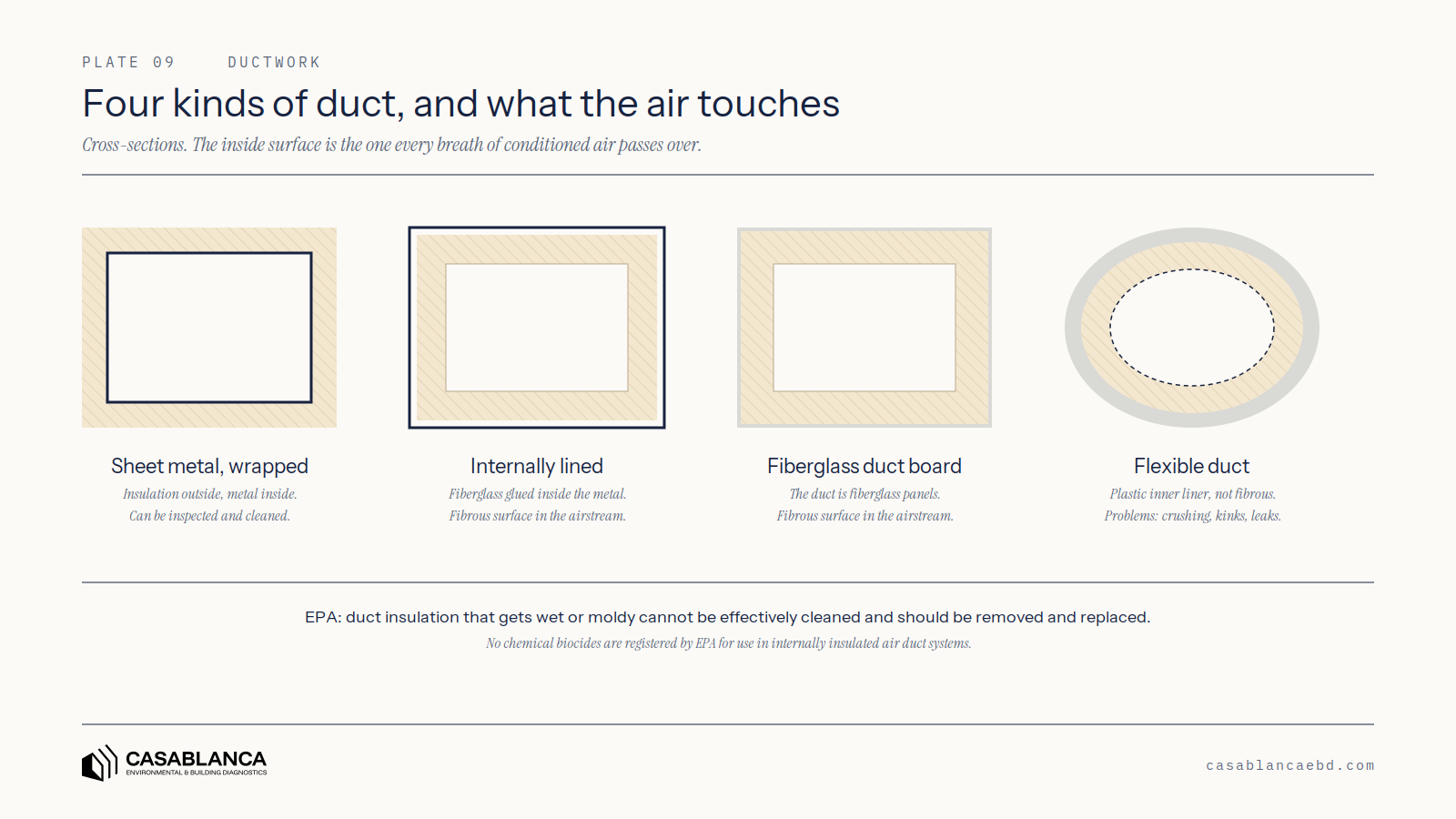
Three kinds of duct are common in East End houses:
Sheet metal duct, galvanized steel with a smooth, hard inside surface. Where it needs insulation, the insulation is wrapped around the outside.
Internally lined sheet metal, where a layer of fiberglass liner is glued and pinned to the inside of the metal. It is common in supply and return plenums and in trunk lines, because it reduces noise and insulates without an outer wrap.
Fiberglass duct board, rigid panels of fiberglass with a foil facing on the outside, cut and taped into rectangular ducts and plenums. The inside face is fiberglass.
Flexible duct has a plastic inner liner, insulation around it, and a plastic outer jacket. Its inside surface is not fibrous, though it has its own problems with crushing, kinks, and leaks.
Why lined ductwork is not sanitary
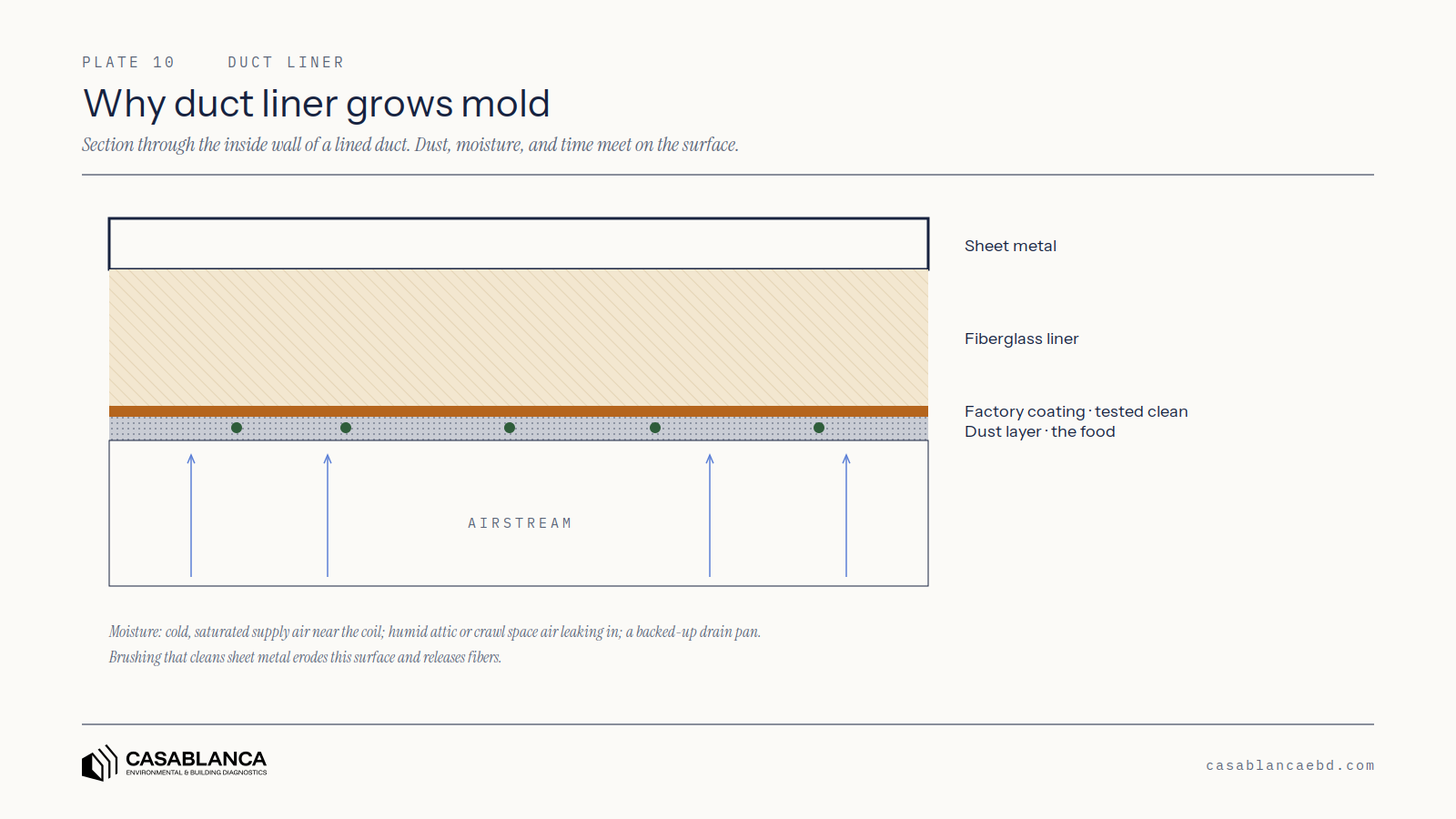
It traps dust. A fibrous surface in moving air catches the fine dust that gets past the filter: skin flakes, pollen, fibers, and organic debris. Over years, that layer builds up in the liner's surface. Mold does not need the fiberglass to grow; it grows on the dust. Liner manufacturers treat the surface with mold-resistant coatings, and new liner passes laboratory mold-resistance tests. Those tests are run on clean material. In a working duct, the growth happens in the dust that settles on the coating, and in liner whose coating has been worn by years of air movement and cleaning.
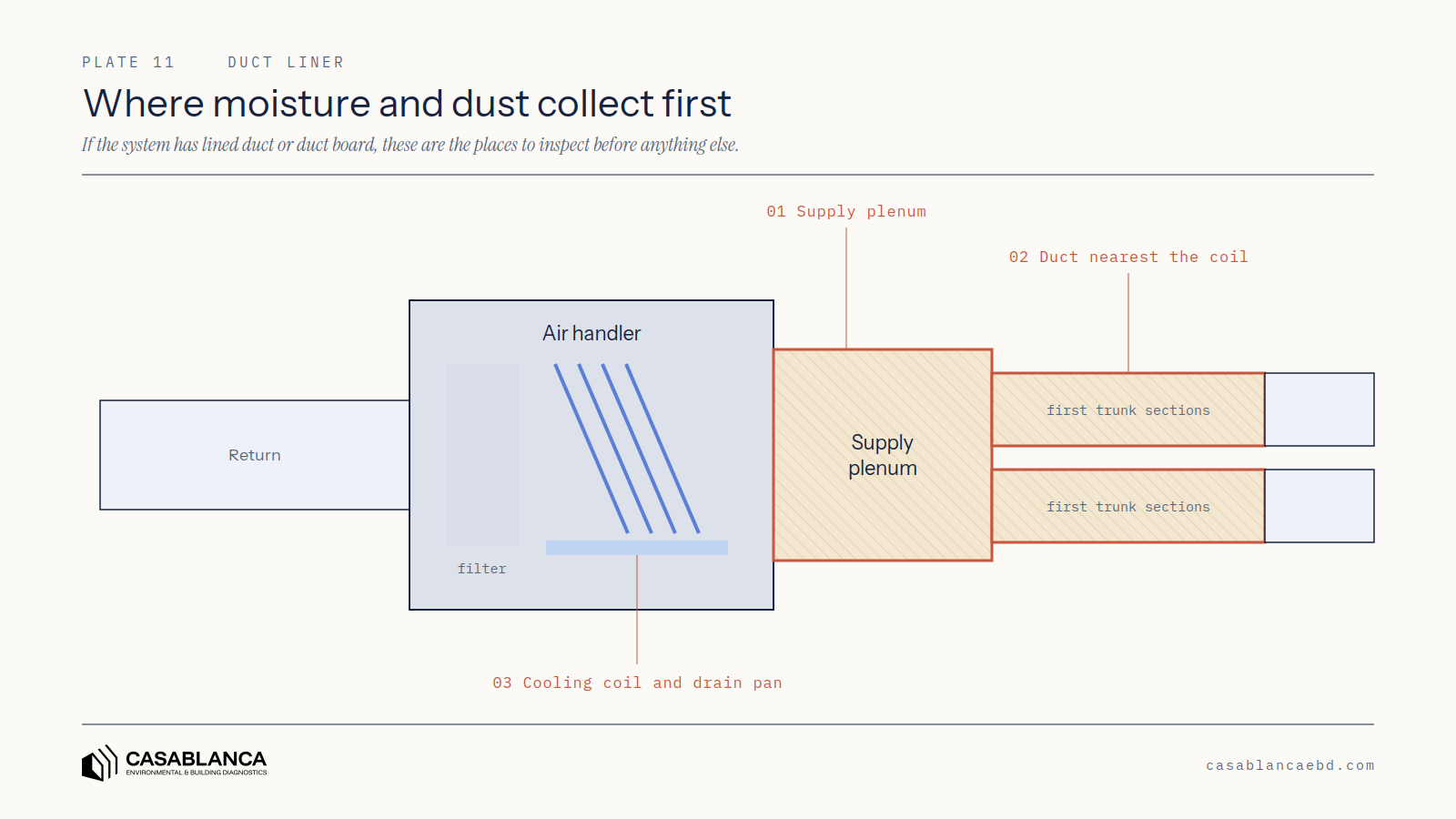
It gets wet. The supply air leaving an air conditioner is cold and close to saturated. The plenum and duct right after the coil, and any duct running through a hot, humid attic or crawl space, see condensation when the system short-cycles, when the drain pan backs up, or when humid air leaks into the duct. A summer on the East End supplies plenty of humid air, and a crawl space that flooded in a storm supplies more.
It cannot be cleaned. EPA's guidance on duct cleaning is direct: if insulated air ducts get wet or moldy, the insulation cannot be effectively cleaned and should be removed and replaced. Brushing and vacuuming that works on sheet metal erodes a fibrous surface and can release fibers into the air. EPA also notes that no chemical biocides are registered for use in internally insulated air duct systems.
Coatings do not fix it. Some duct cleaners offer to spray a sealant or encapsulant over dirty or moldy liner. Industry guidance summarized by InterNACHI is that sealants should never be used on a wet duct liner, to cover actively growing mold, or to cover debris. The same source notes that EPA, the National Air Duct Cleaners Association, and the North American Insulation Manufacturers Association all recommend replacing wet or moldy fiberglass duct material.
The system delivers it to every room. The ductwork is the one part of the house every breath of conditioned air passes through. Growth on the inside of a supply plenum is upstream of every register in the house.
What to do about it
If you are building or renovating:
Specify sheet metal supply and return ducts with the insulation on the outside, as a foil-faced wrap, so the airstream surface is smooth metal that can be inspected and cleaned.
Keep ductwork inside the conditioned part of the house where the design allows. Ducts in a vented attic or crawl space run hotter, colder, and wetter than ducts inside.
If sound control is needed, use lengths of lined duct only where it is needed, away from the cooling coil, and not in the supply plenum.
Make sure the drain pan slopes to its drain and the condensate line is clear, so water does not stand under the coil.
If your system already has lined duct or duct board:
Have the supply plenum, the return plenum, and the first sections of duct near the air handler inspected. That is where moisture and dust collect first.
Replace any liner or duct board that is wet, stained, or growing mold. Cleaning it is not an option under EPA's guidance.
Do not let a duct cleaner fog, spray, or encapsulate fibrous duct material as a substitute for replacing it.
Fix the cause: a clogged drain pan, a coil that sweats into the plenum, leaky return ducts pulling crawl space or attic air, or a system that short-cycles in humid weather.
Keep filters current and properly sized, so less dust reaches the ducts in the first place.

What we do
We perform indoor air quality assessments and mold assessments in the Hamdptons and across the East End, including the air handler, plenums, and accessible ductwork. We identify the duct materials, look for moisture and growth, take samples where the result changes the plan, and write a scope that says what can be cleaned and what has to be replaced. Call or text (631) 655-9855, email bayrona@casablancaebd.com, or send us the address and what you are seeing.
Common questions about lined ductwork and mold
Can fiberglass duct liner be cleaned? Not once it is wet or moldy. EPA's guidance is that wet or moldy insulation in air ducts cannot be effectively cleaned and should be removed and replaced.
How do I know if my ducts are lined? Look into a supply register or the plenum with a flashlight. A smooth, shiny metal surface is bare sheet metal. A dark, fuzzy, or matte surface is liner or duct board.
Is duct board the same as lined duct? Both put fiberglass in the airstream. Duct board is the duct itself, made of fiberglass panels; lined duct is sheet metal with fiberglass glued inside.
Can an antimicrobial spray fix moldy duct liner? No. EPA notes that no biocides are registered for internally insulated ducts, and sealants should not be applied over wet liner or active growth.
Should I have my ducts cleaned every year? EPA does not recommend routine duct cleaning, only cleaning as needed. If the ducts are lined and contaminated, replacement is the fix, not cleaning.
Hamptons and East End questions
Our Hamptons house has ducts in the attic and a musty smell when the AC runs. Could it be the ducts? It can be. Ducts in a hot attic, especially lined plenums at the air handler, take on condensation in a humid summer. Have the air handler, plenums, and ducts inspected along with the rest of the house before deciding what to replace.
The crawl space flooded in the nor'easter, and the ductwork runs through it. What now? Any duct liner, duct board, or flex duct that sat in floodwater should be replaced. Sheet metal duct that was submerged has to be cleaned and inspected, and the air handler checked before the system runs.
Sources and further reading
U.S. EPA, Should You Have the Air Ducts in Your Home Cleaned?
InterNACHI, Duct Cleaning (EPA, NADCA, and NAIMA positions on wet or moldy fiberglass duct material; sealant guidance).