
Why Bleach Does Not Fix Mold on Drywall or Framing
By Bayron Alvarez, NYS Licensed Mold Assessor (#25-671AE-SHMO) and NYS Licensed Home Inspector (#16000145204) — Casablanca Environmental & Building Diagnostics, Southampton, NY
Bleach is the first thing most people reach for, and on a hard, nonporous surface it works. On drywall, framing, subfloor, insulation, and ceiling tile it does not solve the problem, and killing the mold was never the objective. On those materials it does not reliably kill it either: in one laboratory trial on gypsum wallboard and pine, none of ten treatments completely destroyed the viable fungi.
Summary
Bleach works on hard, nonporous surfaces at the label dilution and contact time. On drywall, framing, subfloor, insulation, and ceiling tile it does not, because the growth is inside the material, hypochlorite is consumed by organic matter before it penetrates, and the bottle is mostly water applied to material that is already too wet. Killing the mold was never the objective: dead mold is still allergenic, and the moisture source is unchanged. EPA, CDC, and the New York City health department all direct that wet, colonized porous material be removed and discarded rather than treated. Above 10 square feet, New York Labor Law Article 32 requires a licensed assessor's plan, a separate licensed remediator, containment, and a written passed clearance report from the assessor. A homeowner may do the work on their own property, and under 10 square feet EPA's method is detergent and water, discard of porous material, and fixing the leak.
What bleach does and does not do
The Centers for Disease Control and Prevention permits dilute bleach as one option: "Mold can be removed from hard surfaces with household products, soap and water, or a bleach solution of no more than 1 cup of household laundry bleach in 1 gallon of water." The manufacturer's own guidance is narrower. Clorox states that "bleach is not recommended for treating mold on porous materials," makes its claims for "hard, nonporous surfaces" at a specified dilution with a 10-minute contact time, and advises calling a remediation professional above 10 square feet.
EPA's position for buildings is that "the use of a biocide, such as chlorine bleach, is not recommended as a routine practice during mold remediation, although there may be instances where professional judgment may indicate its use," such as when immune-compromised occupants are present. New York's Department of Labor says the same in its mold FAQ and recommends non-ammonia soap and hot water instead.
Look at the cleanup methods EPA actually lists for each material and area size: wet vacuum, damp wipe with water or water and detergent, HEPA vacuum, and discard. No size and no material lists a biocide as a cleanup method.
Killing it is not the goal
EPA states the principle in two sentences: "It is necessary to clean up mold contamination, not just to kill the mold," and "Dead mold is still allergenic, and some dead molds are potentially toxic." The allergens and proteins that cause reactions are present in dead mold. A surface that has been bleached and left in place is still a source of exposure.
The independent evidence bears that out. A 2019 evidence review for the New Zealand Ministry of Health concluded that "the scientific evidence base from which to formulate advice on mould remediation is very limited," that findings on bleach are inconsistent, and that "no studies have demonstrated treatments that inactivated fungal spores and mycotoxins and destroyed the allergenicity of fungal residues across the full range of fungal species potentially present in the domestic environment." Its recommendation: "the advice offered by the USEPA appears to be the most protective of public health; that is, removal of affected material, rather than use of biocides to remediate, wherever possible."
Two laboratory results in that review make the point concrete. In one study, washing with detergent and bleach "removed or inactivated mycotoxins on paper and cloth, but not on carpet or wood." In another, gypsum wallboard and pine were treated by ten different procedures including heat, boron, ammonium and hypochlorite products: "None of the remediation treatments was able to completely destroy viable fungi," "none of the remediation treatments removed mycotoxins completely," and "fungal growth increased rapidly during the re-moistening period."
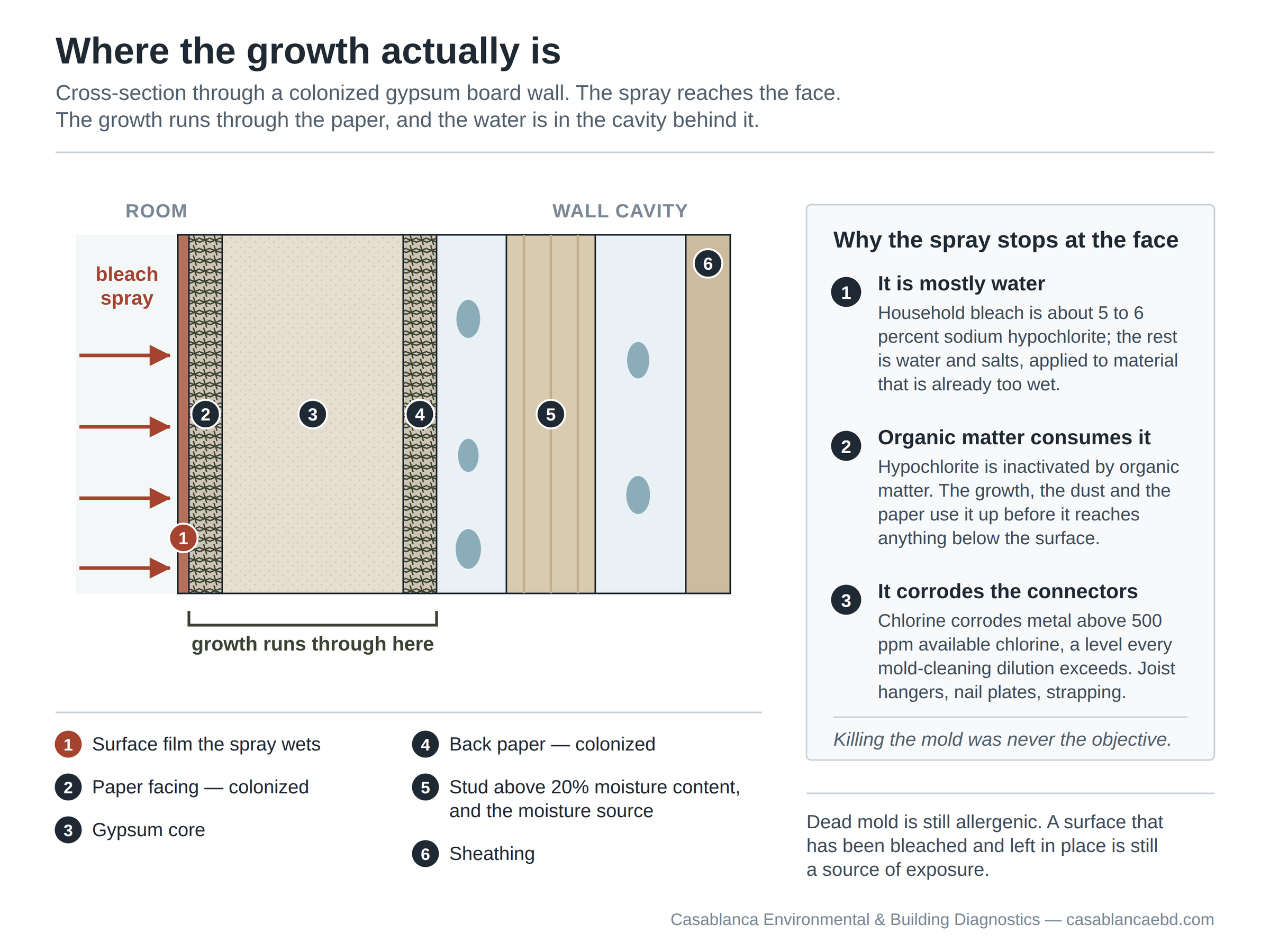
Drywall and framing are porous, and the growth is inside
EPA: "Since molds will infiltrate porous substances and grow on or fill in empty spaces or crevices, the mold can be difficult or impossible to remove completely." The USDA Forest Products Laboratory describes the same thing in wood: "The fungus, in the form of microscopic, threadlike strands called hyphae, permeates the wood and uses parts of it as food."
A spray reaches the face. It does not reach hyphae in the paper facing of drywall or inside the wood. Three chemistry points compound that. Household bleach is about 5 to 6 percent sodium hypochlorite and the rest is water and salts, so spraying it onto framing already above 20 percent moisture content adds water to the problem. Hypochlorite is inactivated by organic matter, so it is consumed by the growth, the dust, and the wood itself before it penetrates anything. And it is corrosive to metals above 500 parts per million of available chlorine, a threshold any mold-cleaning dilution far exceeds, which matters when the spray lands on joist hangers, nail plates, and strapping.
The moisture is the part that decides the outcome. EPA: "If you clean up the mold, but don't fix the water problem, then, most likely, the mold problem will come back."
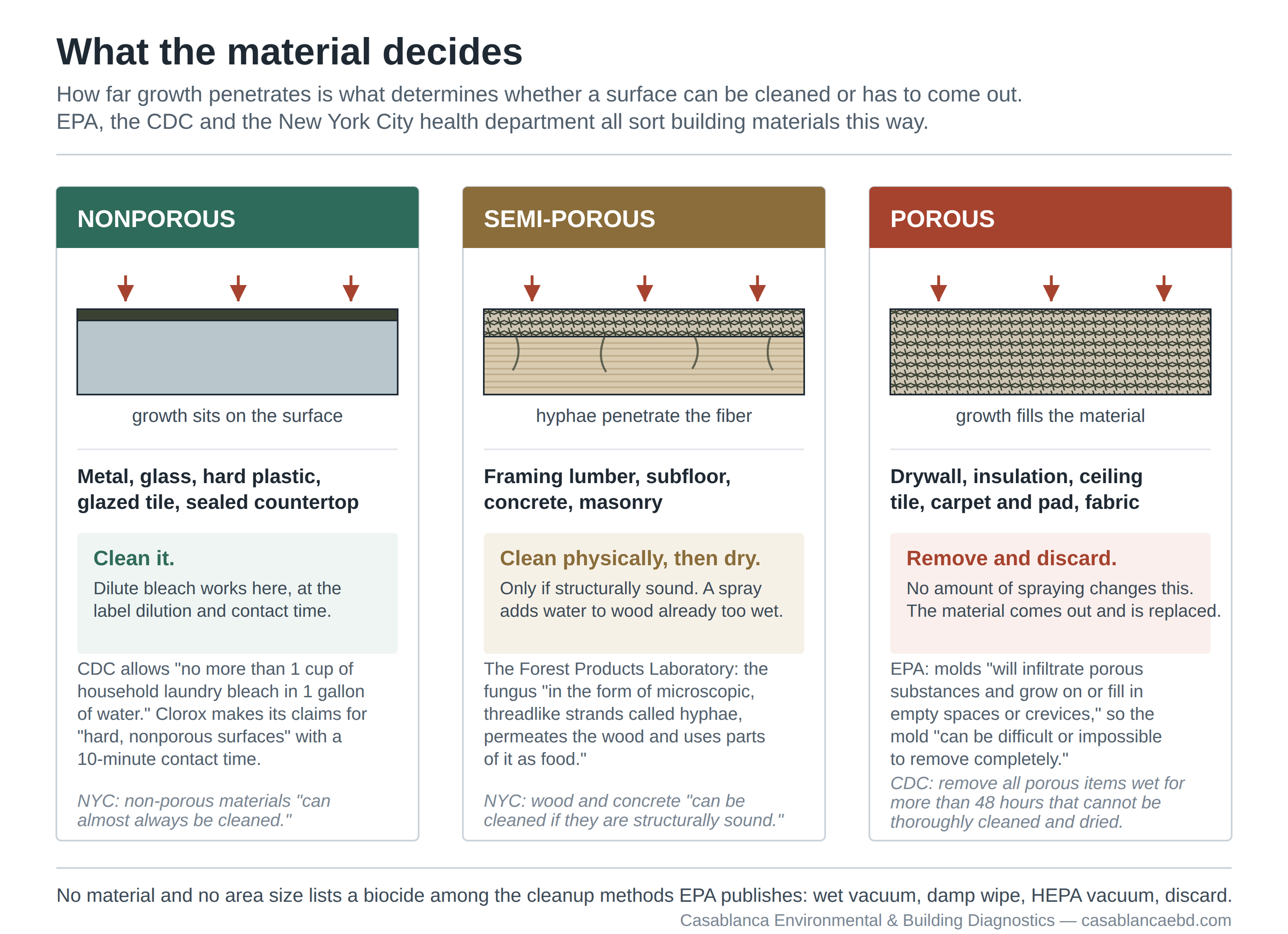
What the agencies say to do instead
For wet, moldy porous materials, all three major guidance documents say the same thing.
EPA's water damage table: wallboard "may be dried in place if there is no obvious swelling and the seams are intact. If not, remove, discard, and replace"; ceiling tiles and insulation, "discard and replace." CDC's post-flood advisory: "Remove all porous items that have been wet for more than 48 hours and that cannot be thoroughly cleaned and dried," naming carpeting and padding, upholstery, insulation, drywall and wallpaper, leather, paper, and wood. New York City's guidelines: "Porous materials, such as ceiling tiles and insulation, and wallboards (with more than a small area of mold growth) should be removed and discarded," while "non-porous materials (e.g. metals, glass, and hard plastics) can almost always be cleaned" and "semi-porous and porous structural materials, such as wood and concrete can be cleaned if they are structurally sound," using "a soap or detergent solution."
New York City's guidance also addresses the sales pitch that replaces removal: "The use of gaseous, vapor-phase, or aerosolized (e.g. fogging) biocides for remedial purposes is not recommended," because "the effectiveness of these treatments is unproven and does not address the possible health concerns from the presence of the remaining non-viable mold." The same document notes that "disinfectants are seldom needed to perform an effective remediation because removal of fungal growth remains the most effective way to prevent exposure."
Two more items from EPA that come up constantly: "Do not paint or caulk moldy surfaces. Clean up the mold and dry the surfaces before painting," because "paint applied over moldy surfaces is likely to peel." And "Do not run the HVAC system if you know or suspect that it is contaminated with mold — it could spread mold throughout the building."
Safety
Do not mix bleach with other cleaning products. CDC: "Never mix bleach with ammonia or other cleaners. This will produce a poisonous gas." Washington State's health department lists the results: bleach plus ammonia produces chloramine gases, with symptoms listed as coughing, nausea, shortness of breath, watery eyes, chest pain, irritation to the throat, nose and eyes, wheezing, and pneumonia and fluid in the lungs; bleach plus an acid releases chlorine gas. The acid list includes vinegar, some glass cleaners, dishwasher detergents and rinses, toilet bowl cleaners, drain cleaners, rust removers, and masonry cleaners. The advice circulating online to spray vinegar and then bleach the same surface produces chlorine gas.
For any cleanup, EPA says you may want to wear an N-95 respirator, and recommends long gloves to mid-forearm and goggles without ventilation holes, and if a disinfectant is used, ventilating the area and exhausting to the outdoors.
What a product label actually means
Under federal pesticide law, with certain exceptions, any product sold to kill mold must be registered with EPA, and "it is a violation of Federal law to use this product in a manner inconsistent with its labeling."
A "fungicidal" claim is narrower than it sounds. EPA's efficacy test guideline for disinfectants covers "use on hard surfaces," and the fungicidal test is run against a single organism, Trichophyton interdigitale, a skin fungus. Additional organisms have to be added to the label individually. A generic fungicidal claim is earned on a hard surface against a dermatophyte, not on drywall against Aspergillus, Penicillium, or Stachybotrys.
New York's mold law builds that into remediation work. Labor Law §946(5): "Disinfectants, biocides and antimicrobial coatings may be used only if their use is specified in a mold remediation plan, if they are registered by the United States Environmental Protection Agency for the intended use and if the use is consistent with the manufacturer's labeling instructions," and the decision "must take into account the potential for occupant sensitivities and possible adverse reactions to chemicals that have the potential to be off-gassed from surfaces coated with the product."
What a licensed remediation involves in New York
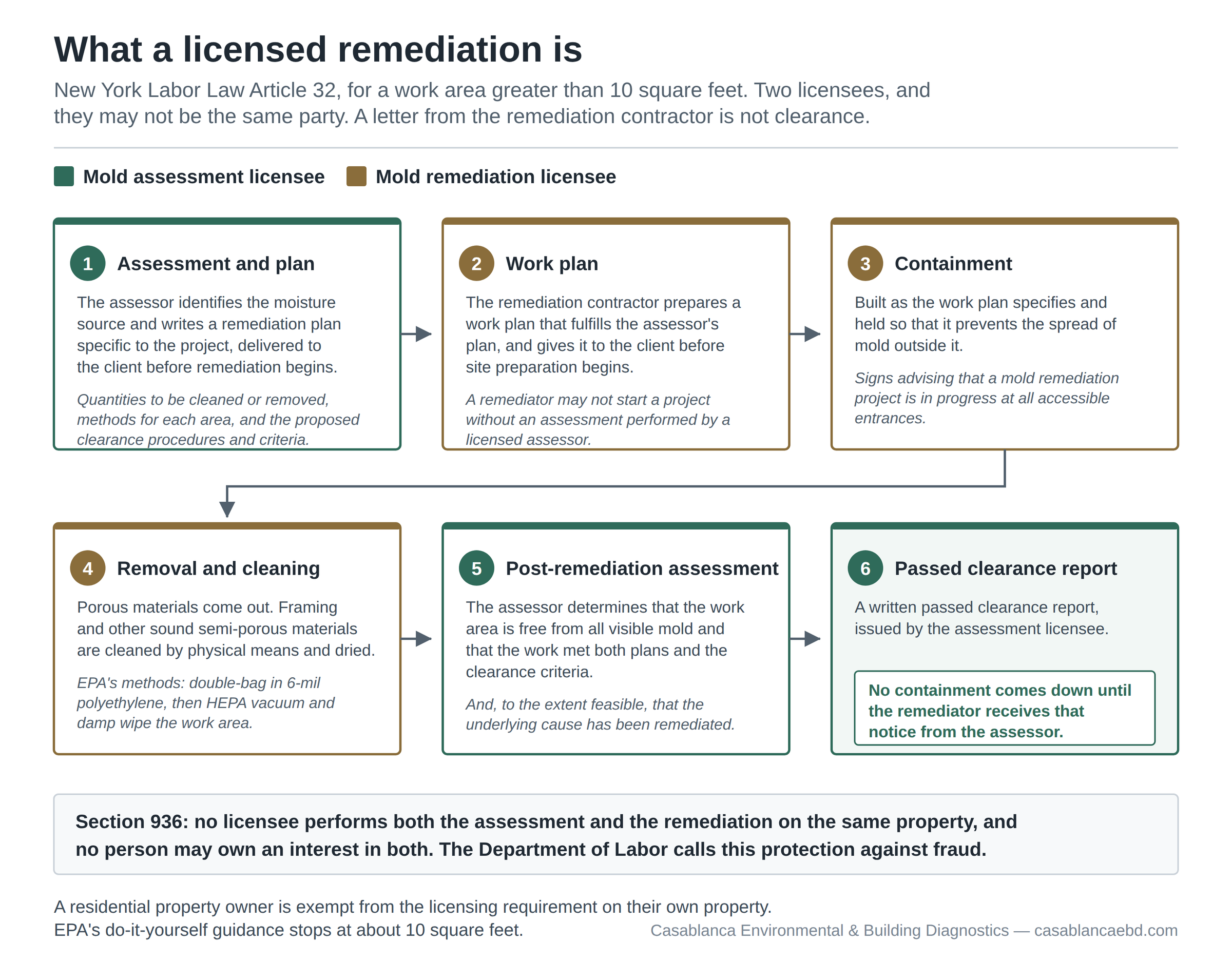
Labor Law Article 32 defines a project as mold assessment, remediation, or abatement of an area greater than 10 square feet. A residential property owner is exempt from the licensing requirement on their own property at any size, though EPA's own do-it-yourself guidance stops at about 10 square feet. Above it, the statute sets the sequence, and the agency guidance fills in the methods:
The assessor identifies the moisture source and prepares a written remediation plan specific to the project, which must include the estimated quantities of material to be cleaned or removed, the methods for each type of area, the proposed clearance procedures and criteria, and, when possible, the underlying sources of moisture with a recommendation for the type of contractor who should correct them. The remediation contractor prepares a work plan that fulfills that plan and gives it to the client before site preparation begins. Containment is built as the work plan specifies and held so that, "when constructed as described in the remediation work plan and under normal conditions of use," it prevents the spread of mold outside the containment, with signs at all accessible entrances. Porous materials come out; EPA's method is to double-bag them in 6-mil polyethylene. Framing and other structurally sound semi-porous materials are cleaned by physical means and dried — the Forest Products Laboratory's margin of safety against fungal damage is 20 percent moisture content or below, though Article 32 sets no moisture criterion of its own. EPA's methods for the work area are HEPA vacuuming and damp wiping. No containment comes down until the remediator has received notice from the assessor that the project achieved clearance. The assessor then performs a post-remediation assessment determining that the work area is free from all visible mold, that the work complied with both plans, and, to the extent feasible, that the underlying cause has been remediated "so that it is reasonably certain that the mold will not return from that remediated area."
Two structural protections matter here. No licensee may perform both the assessment and the remediation on the same property, and no person may own an interest in both. The Department of Labor describes that as "protection against fraud." And the industry standard, ANSI/IICRC S520, is explicit that "physically removing mold contamination is the primary means of remediation," that "antimicrobials should not be used as an alternative to cleaning procedures and physical removal of mold contamination," and that "mold-resistant coatings should not be used as 'sealants' or 'encapsulants' to contain or cover active, viable mold growth." The 2024 fourth edition placed more emphasis on discouraging spraying products before physical removal.
What we do
We perform mold assessments and post-remediation verifications, and by law we do not perform remediation on any property we assess. An assessment identifies the moisture source, maps the extent with meters and thermal imaging, samples where the result will change the plan, and produces the remediation plan the contractor has to follow. Call or text (631) 655-9855 or email bayrona@casablancaebd.com.
Common questions about bleach and mold
Does bleach kill mold? On hard, nonporous surfaces, at the label dilution and contact time, yes. It does not remove the residue, it does not reach growth inside drywall paper or wood, and EPA does not list it as a cleanup method for any material or area size.
If it looks clean after bleaching, is the problem fixed? No. Dead mold is still allergenic, the material is still colonized below the surface, and the water source is unchanged. In the laboratory, growth returned rapidly once treated material was re-wetted.
Is vinegar, hydrogen peroxide, or a botanical spray better? The evidence base for all of them is thin and inconsistent. Any product used in a remediation has to be EPA-registered for the intended use and applied per the label, and none of them substitutes for removal.
Can I do it myself? Under 10 square feet, EPA, CDC, and the New York Department of Labor all say a homeowner can, with EPA's recommended gloves and goggles and, if you choose, an N-95 respirator, using detergent and water, discarding wet porous materials, and fixing the leak. An owner is exempt from the licensing requirement on their own property. Above 10 square feet, a hired contractor needs a license, an independent assessment, a written plan, and a clearance.
What does a licensed remediator do that I cannot? Build and hold the containment the assessor's plan specifies, remove and bag porous materials in a controlled way, clean and dry the framing, HEPA-vacuum and damp-wipe the work area to EPA's methods, and leave the containment standing until an independent assessor issues the clearance.
East End questions
The underside of my subfloor over the crawl space is black. Can I spray it? No. That growth is condensation-driven, and the wood is usually above 20 percent moisture content already; a spray adds water, gets consumed by the organic material, and corrodes the hangers. The correction is the crawl space assembly itself, covered in our article on crawl space condensation, plus physical cleaning under a plan.
Our summer house closets grow mold every July and we bleach them each season. Why does it come back? Because the house sits closed at the outdoor dew point with cooling off, and exterior-wall closets are the coldest, stillest surfaces in it. Bleach removes the film; the relative humidity at that surface is what produces the growth. Hold the indoor dew point below 60°F with dedicated dehumidification and get air movement into the closets.
The seller says the basement was "treated with bleach." Is that a remediation? No. An owner may work on their own property, but there was no assessment, no remediation plan, no removal, and no clearance. The Property Condition Disclosure Statement still asks whether the property has been tested for indoor mold, whether there is rot or water damage, and whether the structure has experienced water penetration or seepage. Bleaching a wall does not change a moisture meter reading, a thermal image, or a tape lift.
Sources and further reading
U.S. EPA: Mold Remediation in Schools and Commercial Buildings, Chapter 3, Chapter 4 and Chapter 5; A Brief Guide to Mold, Moisture and Your Home; Should I use bleach to clean up mold?; Ozone Generators That Are Sold as Air Cleaners.
Centers for Disease Control and Prevention: Mold; Returning Home After a Natural Disaster; 2008 advisory on mold cleanup after flooding; Guideline for Disinfection and Sterilization: Chemical Disinfectants.
New York City Department of Health and Mental Hygiene, Guidelines on Assessment and Remediation of Fungi in Indoor Environments (2008).
New York State Department of Labor, Mold Frequently Asked Questions and Mold Program.
New York State Labor Law Article 32: §930 Definitions; §933 Exemptions; §936 Licensee duties; prohibited activities; §945 Minimum work standards for mold assessments; §946 Minimum work standards for mold remediation; §947 Post-remediation assessment and clearance.
ANSI/IICRC S520, Standard for Professional Mold Remediation — the three principles quoted above are from the 2015 third edition; the fourth edition (2024) is current, and ANSI's summary of what changed in it is the source for the emphasis on physical removal before spraying.
Institute of Environmental Science and Research (New Zealand), Decontamination of Mould-Affected Environments: Advice and Evidence of Efficacy (FW19022, June 2019, for the NZ Ministry of Health).
USDA Forest Products Laboratory, Wood Handbook, FPL-GTR-190, Chapter 14: Biodeterioration of Wood.
U.S. EPA: Summary of the Federal Insecticide, Fungicide, and Rodenticide Act; What are Antimicrobial Pesticides?; Introduction to Pesticide Labels; OCSPP 810.2200 efficacy test guideline.
Washington State Department of Health, Bleach Mixing Dangers; Clorox, Does Bleach Kill Mold?; University of Florida IFAS, Beyond bleach: mold a long-term problem after flooding and disasters.
New York Real Property Law §462, Property Condition Disclosure Statement.