
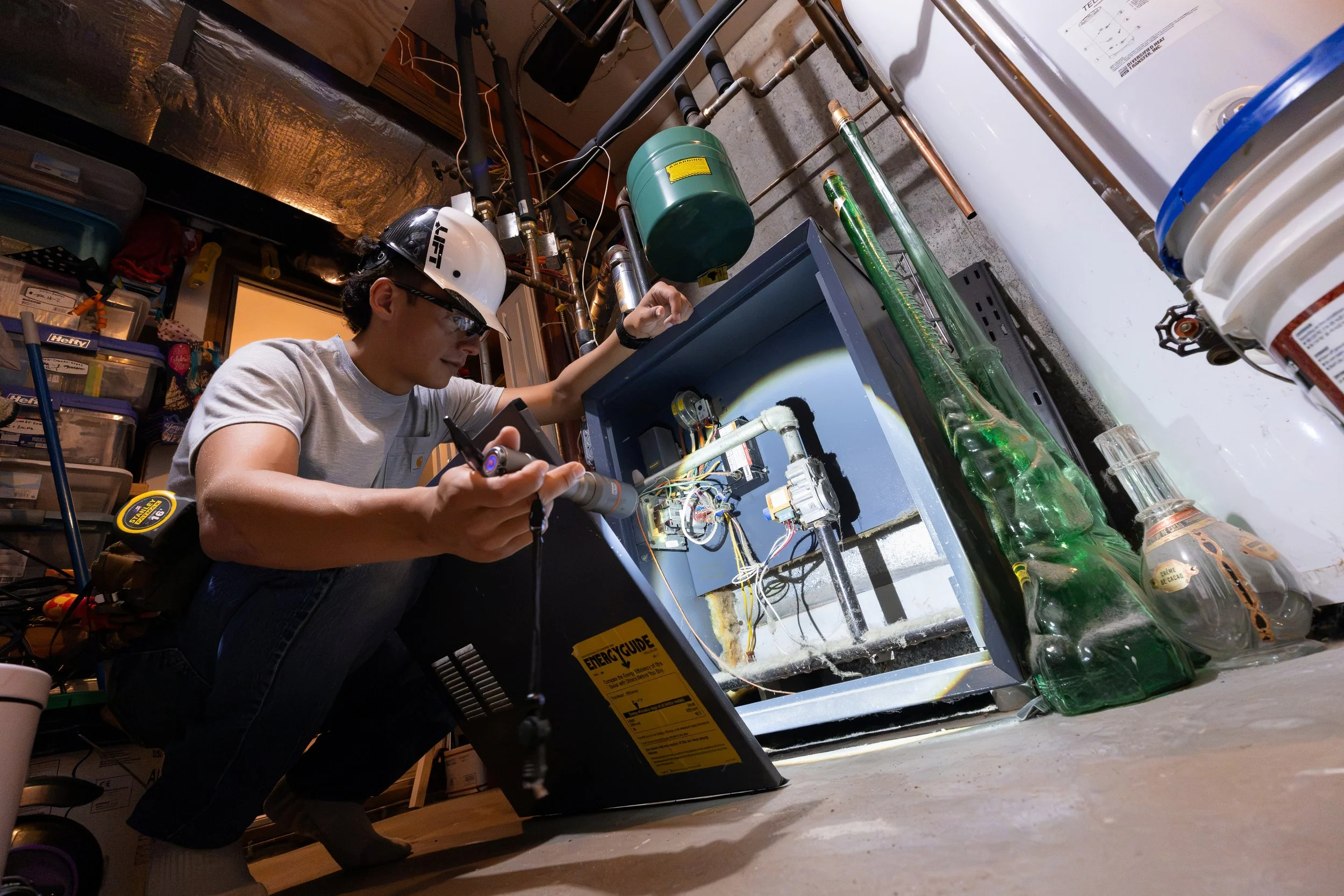
Professional Indoor Air Quality Assessments Suffolk County, NY
Independent IAQ testing with clear, professional reporting. Local. Thorough. Easy to understand.
We provide independent indoor air quality (IAQ) assessments for homes across Suffolk County, Long Island, including the East End (Hamptons and North Fork): Southampton, East Hampton, Sag Harbor, Bridgehampton, Westhampton Beach, Hampton Bays, Montauk, Shelter Island, and Greenport, and west to Patchogue, Smithtown, and Port Jefferson.
There is no single test for "air quality." We build each assessment around your concern, whether that's a smell that won't go away, a family member who feels better away from the house, a renovation that still smells like one, or a seasonal home closed up since Labor Day. Then we measure what matters for that question: a building walkthrough, real-time instrument readings, and laboratory sampling where it adds real information, explained in plain language.
We don't perform remediation or sell duct cleaning, filtration, or air purifiers. What you get from us is an honest answer and a practical plan.
When to Request an IAQ Assessment
Headaches, congestion, irritated eyes or throat, or allergy symptoms that ease when you leave the house
A chemical or "new house" odor after construction, a renovation, or new flooring, cabinetry, or furniture
Stuffy, stale, or humid air; condensation on windows; rooms that never feel fresh even with the AC running
A musty odor with no visible mold, often a sign of hidden moisture or an under-ventilated basement or crawlspace
A seasonal, newly purchased, or professionally managed home you'd like checked before family or guests arrive
Wildfire-smoke or brush-fire days, and a question about whether your HVAC and filtration are keeping it out
A gas range, fireplace, wood stove, or attached garage you'd like checked for combustion by-products
A sewage backup, cesspool problem, or persistent sewer-gas odor
Why indoor air deserves attention on the East End
Houses here work harder than most. A few local realities shape almost every assessment we do.
Humidity. July is Southampton's muggiest month (roughly half its days rate muggy or worse), and that ocean air finds its way into basements, crawlspaces, and closed-up rooms. Elevated indoor humidity is the most common IAQ finding we see; it drives mold growth and dust-mite populations long before anything is visible.
Seasonal occupancy. Nearly half the housing units in the Southampton and East Hampton area are seasonal or occasional-use homes. A house that sits closed with the thermostat set high gets no fresh-air exchange, and often no one notices a small leak until it's a large one.
New construction and renovation. Today's homes are tight by design: New York's current energy code requires new houses to pass a blower-door test at 3 air changes per hour or less, with whole-house mechanical ventilation. That's good building science, but a tight house concentrates whatever is inside it if the ventilation was never commissioned, was switched off, or was never sized for how the home is actually used. New cabinetry, engineered flooring, millwork, and furniture release formaldehyde and other volatile organic compounds (VOCs) for months, and heat and humidity speed the release.
Outdoor events. Canadian wildfire smoke triggered air-quality health advisories for Long Island in June 2023, June 2025, and July 2026, when East Hampton readings climbed into the 140s on the Air Quality Index. The nearest state air monitor is in Riverhead (there isn't one on the South Fork), so what's happening inside your house is something you measure, not something you look up.
Combustion and wastewater. About three-quarters of Suffolk County residents rely on cesspools or septic systems, so sewer-gas odors and backup contamination come up often. And in a tightly sealed home, atmospherically vented appliances and fireplaces can backdraft when exhaust fans or a dryer depressurize the house.
What We Measure and Sample
Real-time readings
Most of the picture is captured during the visit itself with a TSI Q-Trak XP, a professional multi-parameter IAQ monitor. Temperature, relative humidity, and dew point tell us whether the house is running in the range that discourages mold and dust mites. Carbon dioxide is our best on-site indicator of ventilation. Outdoor air is roughly 425 to 430 ppm, and a modest rise indoors is normal wherever people are breathing; what tells us a space isn't getting enough fresh air is a reading that climbs well above that and stays there, a closed bedroom overnight being the classic example. Carbon monoxide readings catch combustion problems at concentrations far below the level at which a home CO alarm sounds. Particle mass readings (PM1, PM2.5, PM10) show how much fine dust and smoke is actually in the air you breathe and whether your filtration is keeping up. A low-range photoionization detector reads total VOCs down to 10 parts per billion, and a formaldehyde screening sensor flags elevated levels; together they tell us where laboratory sampling is worth doing. Where it helps, the monitor is left in place to log conditions minute by minute over a day or more.
Mold spore-trap air sampling
Cassette samples (Air-O-Cell / Allergenco-D) draw a measured volume of air that is examined microscopically for spore types and concentrations, reported in spores per cubic meter and compared against an outdoor baseline collected the same day. This is the same method used in our mold assessments, performed under our NYS Mold Assessor license, and it's the right tool when the question is "is something growing in here?" When the question is "what is this dust?", the same cassette can also be analyzed for dust characterization: pollen, skin cells, cellulose, synthetic and glass fibers, insect fragments, and soot-like opaque particles, each identified and counted per cubic meter.
Volatile organic compounds (VOCs)
For chemical odors, off-gassing, and post-renovation concerns, we collect a whole-air sample in an evacuated stainless-steel "Summa" canister analyzed by EPA Method TO-15, a GC/MS analysis that identifies and quantifies 74 target compounds (benzene, toluene, xylenes, chlorinated solvents, and others). For odor investigations we usually add a library search, which reports tentatively identified compounds outside the standard list; that is often where the answer to a mystery smell is found. A sample can be a short grab sample or time-integrated over 8 to 24 hours to capture typical living conditions. Results are compared against EPA residential screening levels and NYS Department of Health guidance values. One important limit: formaldehyde is not reliably captured by this method and is sampled separately.
Formaldehyde
Formaldehyde is the most common VOC concern in new or renovated homes because it's released by composite wood products (cabinetry, plywood, MDF, particleboard, laminate flooring) and by some finishes and furnishings. Our monitor's formaldehyde sensor gives an on-site screening reading; to quantify it at the concentrations that matter in a home, we sample with a passive badge exposed for 8 to 24 hours under normal closed-house conditions (or a pumped sorbent tube for a shorter sample). Federal rules limit how much formaldehyde composite wood may emit, but no federal standard limits the concentration in your home's air, so results are interpreted against established health-based reference values.
Indoor allergens
For allergy and asthma concerns, we collect settled dust from carpet, mattresses, and upholstered furniture with a filter-collection device on a vacuum and have it analyzed for dust mite (Der p 1 and Der f 1), cat (Fel d 1), dog (Can f 1), cockroach, mouse, and rat allergens. Results are reported per gram of dust and interpreted against published thresholds for sensitization and symptoms.
Bacteria
After a sewage backup, cesspool failure, or suspected contamination, surface samples are screened for total coliforms, E. coli, and Enterococcus, with Bacteroides source-tracking available to identify human-source contamination, which matters because a negative coliform result alone doesn't rule out sewage. Culturable airborne bacteria sampling and endotoxin testing are available for specific situations.
Also available for specific investigations: a sulfur-gas profile (hydrogen sulfide and mercaptans) collected in the same type of canister for sewer-gas odors, and combustion by-product testing (char, soot, and ash) for fireplace, candle, or fire-related residue.
Not included by default: radon, asbestos, and lead. If any of these are part of your concern, tell us when you book and we'll explain the right path.
Our Approach
1) Concern-driven scope. Before we arrive, we ask what you're noticing, where, when it started, and what changed in the house around that time: a renovation, new furniture, a leak, a new HVAC system, a change in occupancy. That conversation decides which measurements and samples make sense. We don't run every test on every house; "test everything" panels produce a pile of numbers with no question attached.
2) Walkthrough and building diagnostics. Air problems are usually building problems first. We look at the envelope, moisture conditions, basement and crawlspace, HVAC filtration and condensate handling, exhaust fans, any ERV/HRV, and combustion-appliance venting, with thermal imaging where it helps.
3) Real-time readings, room by room. A professional multi-parameter IAQ monitor captures temperature, relative humidity and dew point, carbon dioxide, carbon monoxide, fine particulates (PM1/PM2.5/PM10), and screening-level total VOC and formaldehyde readings, compared against an outdoor reading taken the same day.
4) Laboratory sampling, when it answers a question. Spore-trap, VOC, formaldehyde, allergen, or bacteria samples are collected by the method that fits the concern and analyzed by an AIHA-LAP accredited laboratory.
5) Report and plan. A written report explains what we measured, how it compares to recognized reference points, and what to do about it, in order of priority.
Sometimes what we see on site changes the plan. If the walkthrough or screening readings point to something outside the original scope (a solvent-type odor that warrants a canister VOC sample, for example), we'll explain what we found, what the added sampling would tell you, and what it costs before anything is added. Some methods use equipment ordered for the specific job (VOC canisters, flow controllers, specialized media), so that sampling is sometimes scheduled as a short follow-up visit.
How Results Are Interpreted
There is no single federal standard for the air inside a home, and no test that certifies a house "safe." What exists are recognized reference points, and we tell you which one applies:
Humidity:EPA recommends keeping indoor relative humidity below 60 percent, ideally 30 to 50 percent.
Fine particulates (PM2.5):EPA's ambient standards (9.0 µg/m³ annual; 35 µg/m³ 24-hour) and WHO's 2021 guidelines (5 and 15 µg/m³). These are outdoor standards, but they are the accepted yardsticks indoors as well.
Carbon monoxide:EPA's 9 ppm (8-hour) standard. Homes without gas stoves typically read 0.5 to 5 ppm; a home CO alarm is not designed to sound below 30 ppm.
Carbon dioxide: Per ASHRAE's 2025 position document, CO2 at typical indoor levels is a ventilation indicator, not a pollutant. We read it against the outdoor level and how the space is used, not against the outdated "1,000 ppm" rule, which ASHRAE has removed from its standard.
Formaldehyde:WHO's 0.1 mg/m³ (30-minute) indoor guideline, the NIOSH recommended exposure limit (0.016 ppm), California's chronic reference level (9 µg/m³), and the WELL and LEED thresholds (27 and 16 ppb). For context, the median U.S. home measures about 20 µg/m³ (roughly 16 ppb); new homes have measured at more than three times that in their first year.
VOCs: Individual compounds against EPA residential screening levels and NYS DOH air guideline values. A total-VOC result above 500 µg/m³ is treated the way LEED and WELL treat it: a trigger to look for sources, not a pass/fail line.
Mold and allergens:There is no permissible exposure limit for spores; indoor results are read against the outdoor baseline and building conditions. Dust-mite allergen above about 2 µg per gram of dust is associated with sensitization, and above about 10 µg/g with symptoms in people already allergic.
Readings are a snapshot of the day of the visit. Our job is to tell you what's typical, what's elevated, why, and what to do first.
Deliverables
You'll receive clear documentation that typically includes:
A straight, executive-style summary written for a homeowner, not a lab technician
A room-by-room readings table with the outdoor comparison
Laboratory reports appended in full, with a plain-English interpretation
Photographs and thermal images where they explain a finding
Prioritized recommendations: source control first, then ventilation, then filtration
Standards & Guidance Referenced
US EPA: The Inside Story: A Guide to Indoor Air Quality; National Ambient Air Quality Standards; Compendium Method TO-15; Regional and Vapor Intrusion Screening Levels
ASHRAE 62.1-2025 and 62.2-2025 (Ventilation and Acceptable Indoor Air Quality); ASHRAE 55-2023; ASHRAE Position Document on Indoor Carbon Dioxide (2025)
WHO Guidelines for Indoor Air Quality: Selected Pollutants (2010) and Global Air Quality Guidelines (2021); NIOSH Method 2016; NYS Department of Health air guideline values
AIHA: Recognition, Evaluation, and Control of Indoor Mold (2nd ed., 2020) and The IAQ Investigator's Guide (3rd ed.); ANSI/IICRC S520-2024
NYS Labor Law Article 32; 2025 Energy Conservation Construction Code of New York State
Important Notes
Observations and readings reflect conditions at the time of the visit; indoor air changes with weather, occupancy, and building operation. Results are time-specific.
We do not provide medical advice. If you have symptoms you think are related to your home, discuss them with your physician; our report can give your doctor useful context.
We are independent diagnostics. We do not perform remediation, sell products, or accept referral fees. Lab fees and specialized sampling equipment (such as VOC canisters) are itemized on your estimate.
Schedule an IAQ Assessment
Text/call (631) 655-9855, email bayrona@casablancaebd.com, or use the contact form. Include 3 quick details, and we'll recommend the right scope:
What you're noticing (odor, symptoms, humidity, or a specific worry) and where in the house
What's changed recently: a renovation, new furnishings, a leak, a new HVAC system, or a change in how the home is used
Whether the home is occupied year-round or seasonally, and any timing constraints (arrivals, closings, contractors)
FAQ
How is an IAQ assessment different from a mold assessment?
A mold assessment answers a specific question (is there mold growth, where, how much, and what's driving it) and is a licensed activity under NYS Labor Law Article 32. An IAQ assessment is broader: ventilation, humidity, particulates, combustion by-products, VOCs, formaldehyde, allergens, and mold as one piece of the picture. If mold is your main concern, start with a mold assessment; if the concern is symptoms, odors, or a renovation, start here. We'll tell you which fits.
How long does the visit take, and when do I get results?
The visit depends on the size of the home and the scope, whether one area of concern or a whole-house review. Time-integrated samples (formaldehyde badges and VOC canisters that run 8 to 24 hours) are set up during the visit and retrieved afterward. Spore-trap results typically return within one to three business days; allergen panels and bacteria cultures take one to two weeks; VOC and formaldehyde turnaround varies by method. We'll give you the expected timing for each sample when we scope the job, and rush analysis is available.
My new house or renovation has a strong smell. Should I test for formaldehyde?
Often, yes. That "new" smell is a mix of VOCs, and formaldehyde from composite wood and finishes is the compound with the best-established health reference values; a canister VOC sample identifies what else is in the mix. Just as important, we'll check whether your ventilation is running as designed and whether heat and humidity are accelerating the off-gassing. The fix is frequently a ventilation and conditioning fix, not a demolition.
What should I do before the visit?
Keep the house in its normal condition. Don't air it out or run extra fans beforehand (for VOC and formaldehyde sampling we'll usually ask for windows closed and the HVAC running normally for the 24 hours before), and don't clean more than usual. Hold off on air fresheners, candles, and fresh paint. Have HVAC filter information, service records, and any remodel details handy.
What does canister VOC testing cost?
For reference, laboratory analysis of one Summa canister sample at standard turnaround (about a week) is about $550 for the 74-compound TO-15 scan, or about $630 with the expanded library search we usually recommend for odor investigations, plus canister handling and shipping. Faster turnaround is available at a higher rate, and an outdoor comparison sample is sometimes recommended. Laboratory analysis is billed in addition to the assessment fee, itemized on your estimate so you see the cost before we collect the sample, and follows the laboratory's current rates.
Do you test for radon, asbestos, or lead?
Not as part of a standard IAQ assessment. Suffolk County is EPA Radon Zone 3 (the lowest predicted potential), but EPA still recommends that every home be tested. Let us know at booking and we'll advise on the right path for any of the three.
Wildfire-smoke days: what can actually be done?
Quite a lot. Fine-particle readings inside your home during a smoke event show immediately whether your envelope, filtration, and ventilation settings are keeping smoke out. Higher-efficiency HVAC filters, running the system fan, portable HEPA filtration in bedrooms, and setting an ERV/HRV appropriately during advisories typically make a measurable difference, and the readings prove it.
We're not there most of the year. Can you check the house before we arrive?
Yes. A pre-arrival IAQ check (humidity, ventilation, particulates, and a walkthrough for moisture or odor) is one of our most common requests from owners and property managers on the East End. We can coordinate directly with your house manager or caretaker.
Casablanca Environmental & Building Diagnostics provides mold assessments and mold testing across Suffolk County, Long Island — including the Hamptons and North Fork, plus central and western Suffolk on both the South Shore and North Shore.
Service Areas
East End Long Island
Bridgehampton
Riverhead
South Shore + Central Suffolk
Westhampton
East Quogue
Patchogue
Sayville
Bay Shore
North Shore
Port Jefferson
Stony Brook
Setauket
Smithtown
Mount Sinai
Also Serving
Ronkonkoma
Commack
Kings Park
Halesite
Selden
Yaphank
Mattituck
Wyandanch