
Mold in a Hamptons Summer Rental: What Owners and Tenants Should Do
By Bayron Alvarez, NYS Licensed Mold Assessor (#25-671AE-SHMO) and NYS Licensed Home Inspector (#16000145204) — Casablanca Environmental & Building Diagnostics, Southampton, NY
A Hamptons summer rental is a house that sat closed for most of the year, was opened the week before the tenants arrived, and is now running air conditioning through the most humid months on the East End. That is how mold shows up in July: on the back of a closet wall, under a bathroom vanity, in the basement playroom, or as a smell nobody can place. The tenant wants it dealt with. The owner wants to know what they are responsible for and how to keep the season from falling apart. This post sets out what each side should do, in what order, what New York law and the East End towns require, and how to get the house ready before next season so it does not happen again.
Summary
Summer rentals grow mold because the house was closed and damp for months, then cooled hard in July and August while humid air leaked in. The tenant should photograph what they see, report it to the owner or agent in writing the same day, keep people with asthma or allergies out of that room, and not scrub or spray it. The owner should respond in writing, have a licensed mold assessor look at it within days, fix the moisture source, and, if the growth is more than 10 square feet, follow New York Labor Law Article 32: an assessor's written plan, a separately licensed remediation contractor, and a passed clearance. New York's warranty of habitability applies to every residential lease, including a season rental, and cannot be waived in the lease. The Town of Southampton requires a rental permit with an inspection, which a licensed home inspector can certify, and the Town of East Hampton requires a rental registry number. Before next season, the fix is a spring opening with moisture readings, a dehumidifier set to run, and the air conditioning set to control humidity rather than to chill the house.
Why summer rentals grow mold
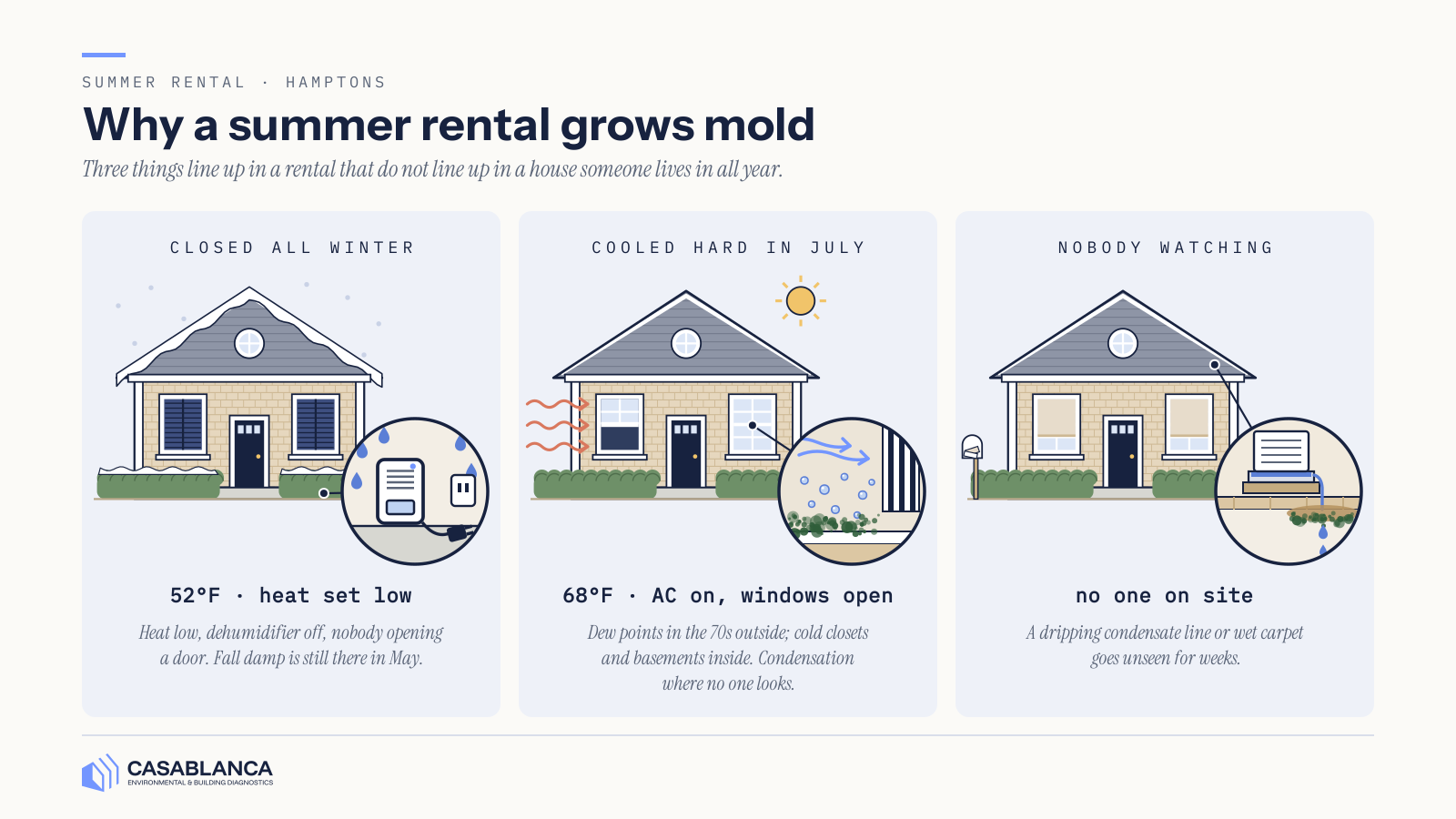
Three things line up in a rental house that do not line up in a house someone lives in all year.
It was closed. From Labor Day to Memorial Day most rentals sit with the heat set low, the dehumidifier off, and nobody opening a door. Our post on thermostat and humidity settings for an unoccupied house covers what happens inside during those months. Anything that was damp in the fall is still damp in May, and a winter leak has had months to work.
It is cooled hard in the most humid months. July and August on the East End bring dew points in the 70s. Air conditioning set low pulls the surfaces of closets, basements, and rooms over crawl spaces below the dew point of the air leaking in from outside, and condensation forms where no one looks. Tenants also leave windows open with the air conditioning running, which does the same thing faster.
Nobody is watching the house. A tenant notices a smell and a dark patch; an owner would have noticed the dripping condensate line or the wet carpet three weeks earlier. By the time the complaint reaches the owner, the growth has had time to spread.
The places it shows up: closet walls that back onto the outside, the wall behind a headboard, bathroom ceilings without a working fan, the basement or lower level, kitchen cabinets under a sink, and the mini-split heads and ducts that move the air. Our post on mini-split mold in Hamptons houses covers that last one.
What the tenant should do
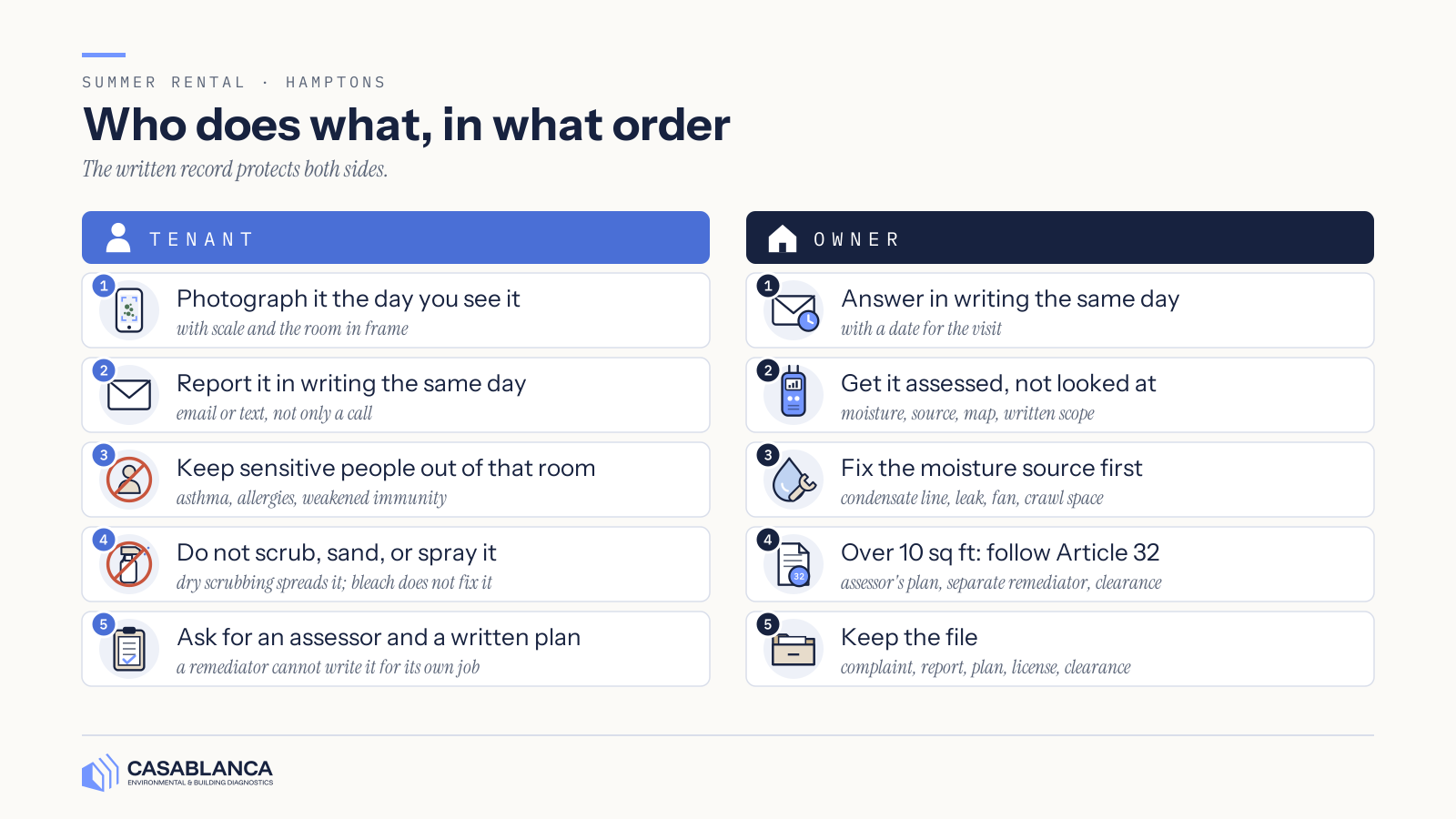
Photograph it the day you see it, with something for scale, and photograph the room so the location is clear. Note the date.
Report it in writing to the owner or the rental agent that day: email or text, not only a phone call. Say where it is, how big it is, and whether anyone in the house has symptoms. Keep the message.
Keep sensitive people out of that room. CDC's guidance is that people with asthma, allergies, or weakened immune systems are more affected by mold. A child's bedroom with growth on the wall is not the room for that child this week.
Do not scrub, sand, or spray it. Dry cleaning releases spores and fragments into the house, and bleach does not remove growth from drywall or framing. A small spot on tile or glass can be wiped with detergent and water. Anything on drywall, wood, or fabric is the owner's to address.
Reduce the moisture you control. Run bathroom fans, keep windows closed when the air conditioning runs, and report any leak, overflowing condensate line, or wet carpet.
Ask for two things: a licensed mold assessor's visit, and a written account of what will be done and when. In New York, a remediation company cannot write that account for a job it will perform.
If the owner does not respond, the warranty of habitability, below, is the tenant's protection. A lawyer, not an assessor, advises on withholding rent or ending a lease.
What the owner should do
Answer in writing the same day, with a date for someone to look at it. The written record protects the owner as much as the tenant.
Get it assessed, not just looked at. A licensed mold assessor measures moisture, finds the source, maps the growth, and writes down what has to be done. A remediation company's free look is not an assessment, and New York does not allow a remediator to assess a job it will then do.
Fix the moisture source first. A condensate line, a roof leak, a bathroom fan that vents into the attic, a crawl space with no vapor barrier. Remediation without this is repeated next season.
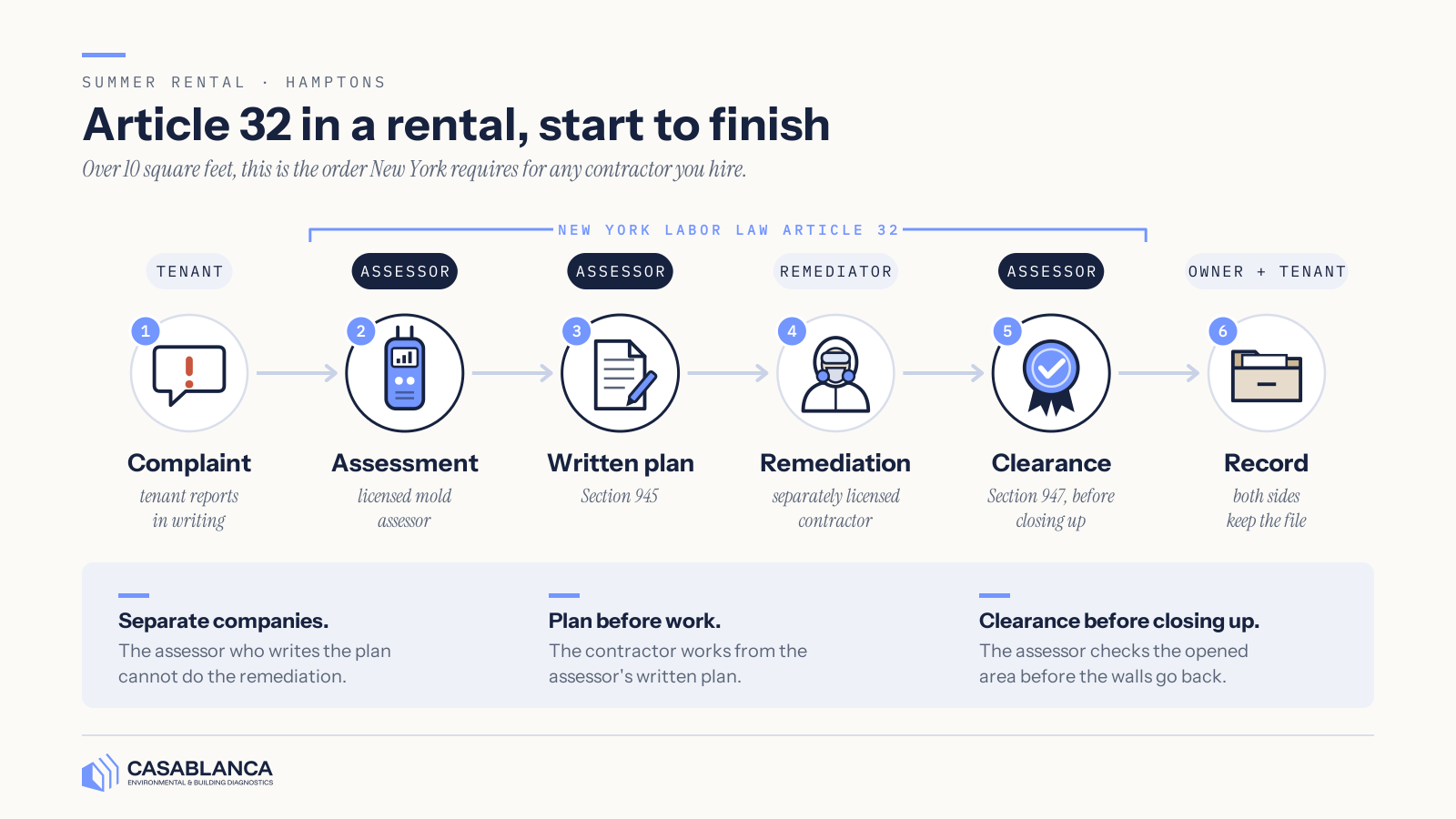
If the work area is over 10 square feet, follow Article 32. The assessor writes the remediation plan, a separately licensed contractor does the work, and the assessor returns for the post-remediation assessment before the area is closed up. Our post on hiring mold remediation in New York covers the rules and the warning signs.
Plan the work around the tenants. Containment and negative air mean the room is out of use for the duration. Small jobs are done in a day or two; a basement takes longer. Say so in writing and offer what the situation calls for.
Keep the file. The complaint, the assessment report, the plan, the contractor's license, the clearance. It answers the tenant, the next tenant, the insurer, and a buyer.
The rules that apply
The warranty of habitability. New York Real Property Law Section 235-b reads into every residential lease, written or oral, a warranty that the premises are fit for human habitation and that occupants will not be subjected to conditions dangerous, hazardous or detrimental to their life, health or safety. It applies to a season rental, and a lease cannot waive it. A condition caused by the tenant's own misconduct is the exception. Whether a particular mold problem breaches the warranty, and what the remedy is, are questions for a lawyer; the point here is that the obligation exists and the record matters.
Article 32. The licensing law applies to anyone an owner hires for mold remediation over 10 square feet: a licensed assessor's plan, a separately licensed remediator, a clearance. An owner working on their own house is exempt from licensing; a property manager or caretaker working for the owner is a question we recommend putting to the Department of Labor.
Town of Southampton rental permit. The town requires a rental permit under Chapter 270, renewed every two years, with a standard fee of $400 and an inspection. The inspection can be done by the town, or the owner can file a certified application in which a licensed architect, engineer, or home inspector certifies that the property complies with the town code and the New York State codes, for a $250 certification fee. A property found in violation of Chapter 270 pays $800.
Town of East Hampton rental registry. East Hampton requires a rental registry number under Chapter 199 of its code, valid for two years, which must appear in every advertisement for the rental. Southold and Shelter Island have rental laws of their own.
Leases and deposits. A good season lease says who maintains the dehumidifier, what the air conditioning setpoint should be, that windows stay closed when it runs, how to report water and mold, and how fast the owner will respond. Mold found at move-out is a deposit dispute only if the lease and the record show whose conduct caused it.
Before next season
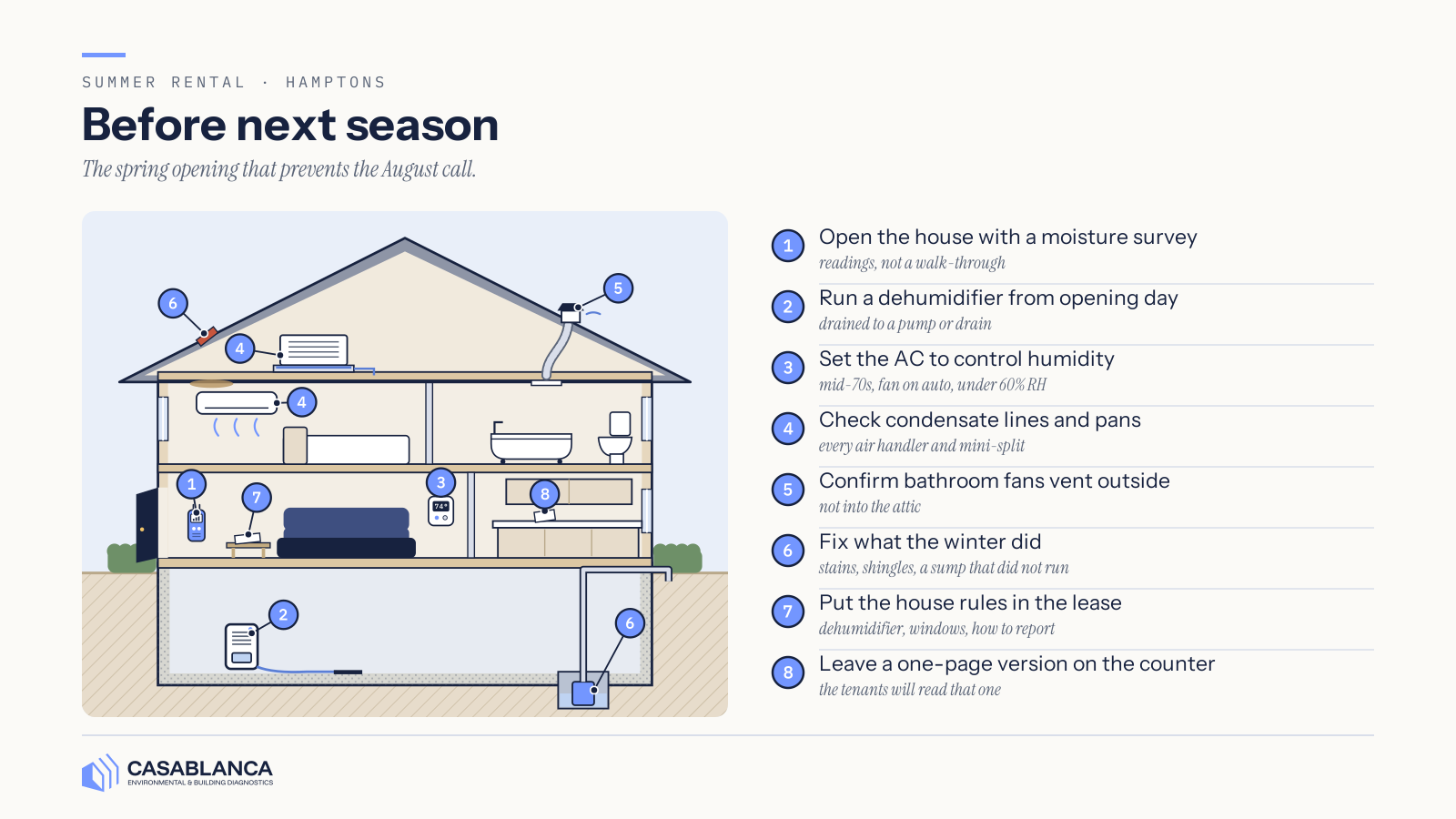
Open the house in April or May with a moisture survey, not a walk-through: readings on basement walls, closets on exterior walls, under sinks, in the crawl space.
Run a dehumidifier in the basement or lower level from opening day, draining to a pump or a drain so it never shuts off full.
Set the air conditioning to control humidity, not to chill the house: a setpoint in the mid-70s with the fan on auto removes more moisture than 68°F with the fan on. Keep indoor relative humidity under 60 percent, and ideally between 30 and 50 percent, per EPA.
Check the condensate lines and pans on every air handler and mini-split before the first hot week.
Confirm bathroom fans vent outside, not into the attic.
Fix what the winter did: stains, lifted shingles, a sump that did not run.
Put the house rules in the lease, and leave a one-page version on the kitchen counter.
What we do
We perform mold assessments, indoor air quality assessments, and post-remediation verifications in the Hamptons and across the East End, and as a New York State licensed home inspector we can complete the certified inspection for a Town of Southampton rental permit. For a rental with a mold complaint, that means a same-week visit, readings, the moisture source, and a written report both sides can rely on. By law we do not perform remediation on any property we assess. Call or text (631) 655-9855, email bayrona@casablancaebd.com, or send us the address and what the tenant reported.
Common questions about mold in a rental
Who pays for the mold inspection, the tenant or the landlord? The owner, in nearly every case. The house is the owner's, the moisture source is in the owner's control, and the warranty of habitability is the owner's obligation. A tenant who wants an independent assessment before a dispute can pay for one, and the report is theirs.
Can the landlord just have a cleaning company wipe it down? For a small spot on a hard surface, cleaning is appropriate. For growth on drywall, wood, or fabric, or anything over 10 square feet, New York requires a licensed assessor's plan and a separately licensed remediator. Wiping drywall does not remove growth in the paper and core.
Can I break my summer lease over mold? That is a legal question that depends on the lease, the severity, and what the owner did once notified. Document everything and talk to a lawyer before withholding rent or leaving.
Does the owner have to tell me if there was mold before? New York's property condition disclosure applies to sales, not rentals. A good owner keeps the assessment and clearance from any prior remediation and shows it on request.
The tenant left windows open with the air conditioning on. Is the mold their fault? It may be a contributing cause, and the lease should say so. Section 235-b excludes conditions caused by the tenant's own misconduct. Whether that applies is a question of evidence: readings, photographs, and the lease terms.
Hamptons and East End questions
Our Southampton rental permit is due. Can you do the inspection? Yes. The town accepts a certified application with an inspection by a licensed home inspector, architect, or engineer. We complete the property inspection checklist and certification; the owner files it with the application and the town's fees.
The tenants are in the house through Labor Day. Can remediation wait? The assessment should not wait; it tells you whether the growth is small enough to handle now or large enough to need containment. Small areas can be addressed between changeovers. A larger job needs the room sealed and out of use, which is better done as soon as a changeover allows than left for September.
We rent a house in East Hampton with a finished basement. What should the lease say? That the dehumidifier runs all season and is not to be unplugged, where it drains, that the basement windows stay closed, how to report water, and who to call. Those four lines prevent most of the calls we get in August.
Sources and further reading
New York Real Property Law, Section 235-b, Warranty of Habitability.
New York Labor Law, Article 32: Section 933 (exemptions), Section 945 (remediation plan), Section 947 (post-remediation assessment).
Town of Southampton, Rental Permit Application instructions and fees; Rental Permit certification form for architects, engineers, and home inspectors.
Town of East Hampton Code, Chapter 199, Rental Registry.
Centers for Disease Control and Prevention, About Mold.