
Single-Stage, Two-Stage, or Variable-Speed AC: What the Difference Means in a Hamptons House
By Bayron Alvarez, NYS Licensed Mold Assessor (#25-671AE-SHMO) and NYS Licensed Home Inspector (#16000145204) — Casablanca Environmental & Building Diagnostics, Southampton, NY
Many HVAC proposals for a Hamptons house offer the same tonnage three ways: single-stage, two-stage, and variable-speed. The difference is how the equipment matches its output to the load. That decides how steady the temperature stays, how much moisture the system removes, what it costs to run, and what it costs to repair. This post explains what "stage" refers to, what each type does at part load, why sizing matters more than the type you buy, what sits above variable-speed, and what to ask before you sign a proposal for an East End house.
Summary
Single-stage, two-stage, and variable-speed describe the compressor: 100 percent or off; about 65 or 100 percent; or continuous adjustment from a model-specific minimum up to 100 percent. That minimum is 25 percent in Trane's description and 40 percent in Carrier's Greenspeed data, and some lines sold as variable-speed run five fixed steps. The blower motor (PSC, constant-torque ECM, or variable-speed ECM) and the thermostat are separate choices, and some variable-speed systems run only with the maker's communicating control. An air conditioner removes moisture only after its coil has run long enough to wet, 60 to 150 seconds into a cycle in testing reviewed by the Florida Solar Energy Center, so short cycles at part load remove less moisture per hour of cooling. Sizing matters more than type. New York's codes require Manual S selection from a Manual J load, and ENERGY STAR's recommended ceilings are 115 percent of the cooling load for single-speed equipment, 120 for two-speed, and 130 for variable-speed. Check the minimum output in Btu/h against spring and fall loads. Above variable-speed are a lower minimum, VRF, geothermal, cold-climate heat pumps, and separate dehumidification, which is what controls humidity in a closed Hamptons house. Set the fan to Auto.
What "stage" refers to
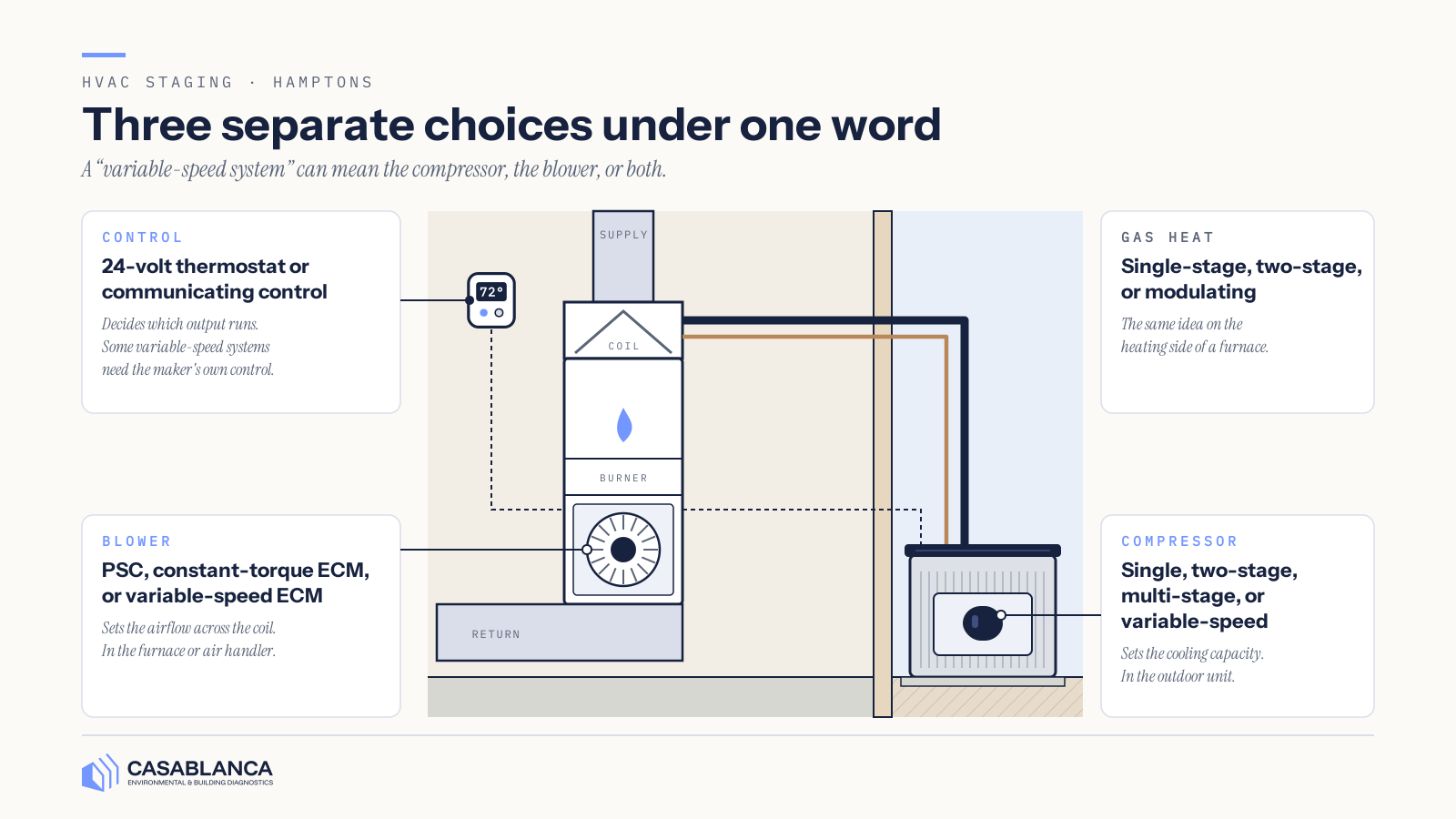
The word is used for three different parts of a system, and a proposal can mix them.
The compressor sets the cooling or heat-pump capacity. It can have one fixed output, two outputs, a few fixed steps, or continuous adjustment. This is what "single-stage," "two-stage," and "variable-speed" describe when they are used correctly.
The indoor blower moves air across the coil and through the ducts. Its motor is a PSC motor, a constant-torque ECM, or a variable-speed ECM, and that choice is separate from the compressor.
The control decides which output runs. A standard 24-volt thermostat sends on and off calls over one or two wires. A communicating control exchanges data with the equipment, and some variable-speed systems will not run without one.
A "variable-speed system" in a proposal can mean a variable-speed compressor, or only a variable-speed blower paired with a single-stage outdoor unit. The second one still cools at full output or not at all. Gas furnaces come in the same three forms on the heating side: single-stage, two-stage, and modulating.
The four types, from simplest to most refined
| Type | Output | At part load | Trade-off |
|---|---|---|---|
| Single-stage | 100 percent or off | Cycles on and off at full output | Lowest first cost, least efficient |
| Two-stage | About 65 percent or 100 percent | Longer cycles on low stage | Middle cost |
| Multi-stage | A few fixed steps, five in one current line | Steps down, then cycles below its lowest step | Steps can depend on the maker's full system |
| Variable-speed (inverter) | A model-specific minimum of about 25 to 40 percent, up to 100 percent | Slows to match the load until it reaches its minimum | Highest first cost, more electronics, matched controls |
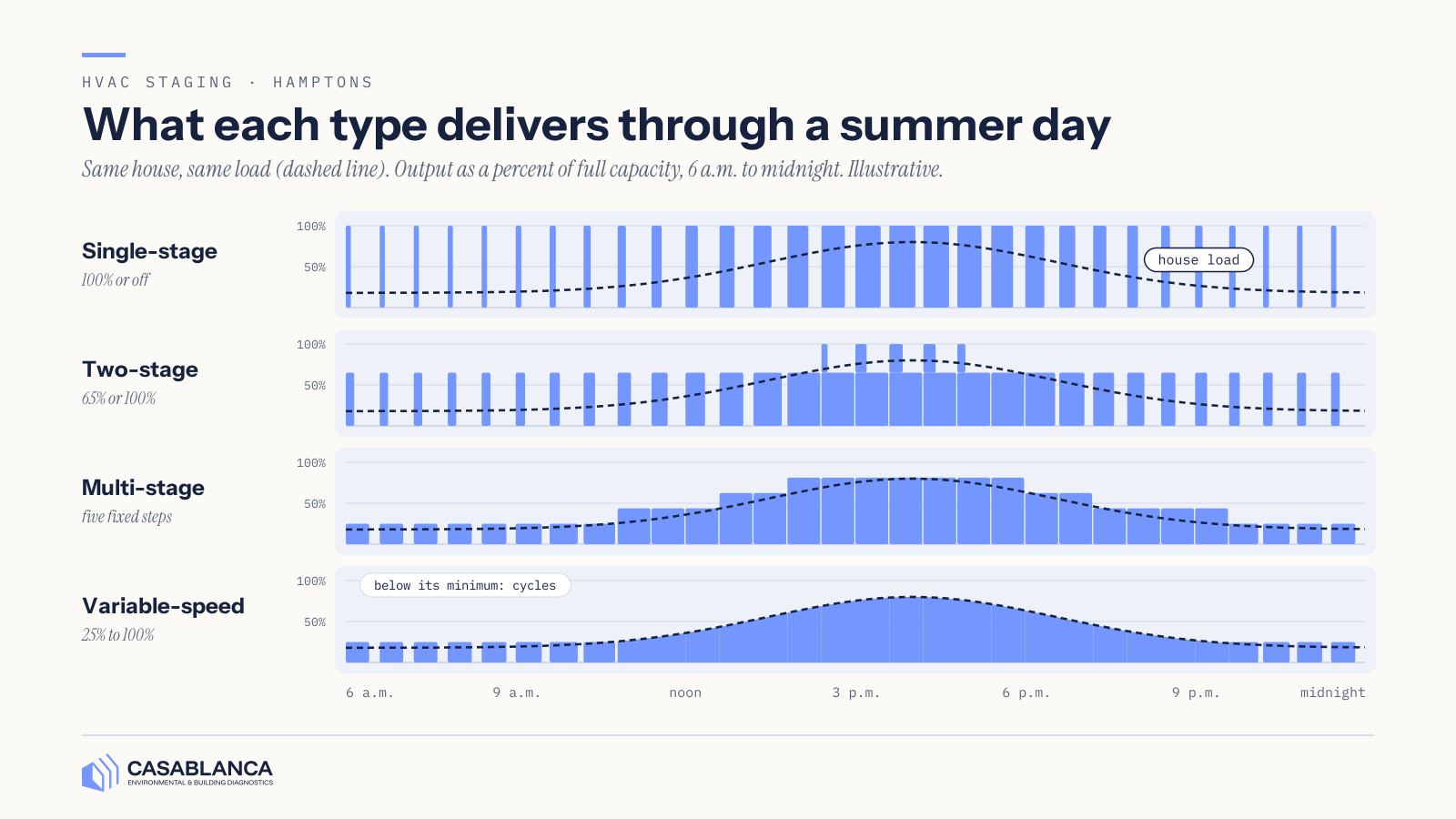
Single-stage. Trane's description is plain: single-stage systems "are the least energy efficient because they must operate at 100% capacity when they're on." On a 75°F June afternoon, a single-stage unit delivers the same output it delivers on the hottest day of the year, so it satisfies the thermostat quickly and shuts off. It has the fewest parts and the simplest repairs. Trane states the trade-off this way: "While single-stage systems are the lowest in cost upfront, they'll cost more to operate in the long run."
Two-stage. "In most cases, the low stage operates at around 65% capacity, while the high stage operates at 100% capacity." When the load is at or below the low stage, the unit runs at about two-thirds output, so each cycle lasts longer than a single-stage cycle at the same load. Trane states that two-stage systems "are more efficient in removing moisture in the air than single-stage systems." A two-stage unit needs a two-stage thermostat, or equipment logic that decides when to move up to high stage.
Multi-stage. Some equipment sold as variable-speed runs a set of fixed steps. Bryant's Evolution V "transitions smoothly between five compressor stages when installed as part of a complete Evolution system" and "allows up to 75 percent capacity reduction," which puts its lowest step near a quarter of full output. The condition, a complete system with the maker's indoor unit and control, is the part of that sentence to read twice.
Variable-speed. An inverter drive changes the compressor's speed in small increments. Trane states that its variable-speed systems "can operate anywhere from 25%-100% capacity." Carrier's Infinity Greenspeed product data lists a "capacity range from 40–100%" and states that the "System requires Infinity Control with Greenspeed capability." The bottom of the range differs by model, and it is the number that matters most in spring and fall, as the sizing section below explains. Trane calls variable-speed systems "the most energy efficient" and the quietest in its line. They also carry the most electronics: an inverter drive in the outdoor unit and communicating control boards, which cost more to replace than the contactor and capacitor of a single-stage unit.
Sensible and latent load: why run time decides the humidity
An air conditioner handles two loads. The sensible load is heat that changes the air temperature. The latent load is moisture: water vapor from outdoor air leaking in, from people, cooking, and showers. The thermostat measures only the first.
The coil removes moisture only when its surface is colder than the dew point of the air crossing it, and only after it has run long enough to wet and start draining. A Florida Solar Energy Center review of part-load laboratory testing reports that "dehumidification of the air began after 60 to 150 seconds of compressor operation depending on the entering air conditions," and "the loss in latent capacity was greater than the loss in sensible capacity as the compressor runtime was decreased." When the compressor stops, "moisture that condenses on the coil surfaces during the cooling cycle evaporates back into air stream when the coil is off" if the blower keeps running.
That is the practical difference between the four types. A single-stage unit at part load runs short cycles, and short cycles remove less moisture per hour of cooling. A two-stage unit on low stage runs longer cycles. A variable-speed unit runs longest, but slowing down has its own limit: at low speed the coil runs warmer. HVAC School published an installer's description of the result: "no part of the evaporator coil surface area is at a temperature far enough below the dew point of the entering air" to condense water, and "the system operates very efficiently at a sensible ratio of 1," meaning all cooling and no drying. Manufacturers answer this with dehumidify settings. Carrier's product data lists "lower speed operation, when needed in cooling, for enhanced comfort and dehumidification" and a separate comfort-plus-dehumidify mode.
The closed seasonal house is the extreme case, because it has almost no sensible load to create run time. Our post on the closed summer house and its thermostat setpoint covers the field research and the dehumidifier sizing.
Sizing before staging, and the East End shoulder season
The code requirement. New York's energy and residential codes require heating and cooling equipment to be "sized in accordance with ACCA Manual S" based on "building loads calculated in accordance with ACCA Manual J" (IECC Section R403.7 and IRC Section M1401.3, as summarized by the ICC's New York code outreach program; New York's own section numbers can differ). ACCA Manual D is the matching method for the ducts. A load calculation is room by room and uses the house's actual insulation, windows, orientation, and air leakage. It is not a square-foot rule.
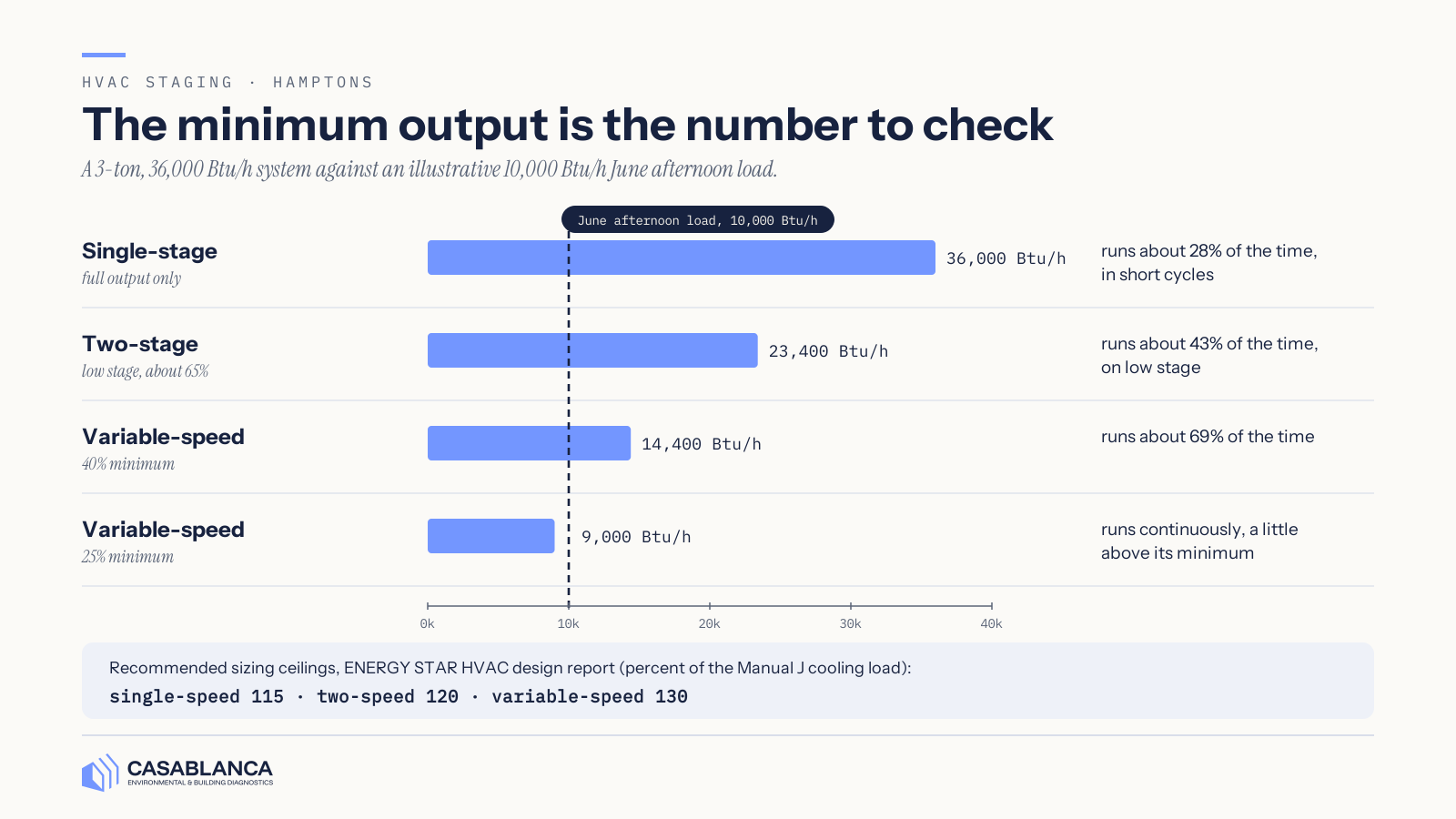
How far above the load. The ENERGY STAR new-homes program's HVAC design report sets cooling capacity as a percentage of the Manual J total cooling load. The recommended ranges are 90 to 115 percent for single-speed equipment, 90 to 120 percent for two-speed, and 90 to 130 percent for variable-speed. The wider "allowed" ceilings are 130, 140, and 160 percent. Variable-speed equipment gets the most room because it can slow down. A heat pump in a heating-dominated climate can be sized up to the cooling load plus 15,000 Btu/h, but under the 2014 edition of Manual S only when the house's sensible heat ratio is 0.95 or higher and its heating degree days are at least twice its cooling degree days.
The minimum is the number to check. Take a 3-ton system, 36,000 Btu/h, and an illustrative June afternoon load of 10,000 Btu/h:
A single-stage unit delivers 36,000 Btu/h whenever it runs, so it runs about 28 percent of the time in short cycles.
A two-stage unit on low stage delivers about 23,400 Btu/h and runs about 43 percent of the time.
A variable-speed unit with a 40 percent minimum delivers 14,400 Btu/h and runs about 69 percent of the time.
A variable-speed unit with a 25 percent minimum can slow to 9,000 Btu/h, so it runs continuously a little above its minimum.
A seasonal house on the East End spends much of May, June, September, and October at loads well below its design day, and a closed house has almost no load at all. In the setpoint post linked above, the point is that an empty house makes even a correctly sized system short-cycle the way an oversized one does.
Heat pumps and the heating load. PSEG Long Island's 2026 heat pump rebate requires that the system "must meet 100-120% of the ENTIRE dwelling heating load" and that a Manual J be done. On Long Island the heating load usually sets the size of a heat pump, so its cooling capacity can end up above the cooling load. A variable-speed unit with a low minimum handles that better than a single-stage one, but the minimum still has to be checked against the summer part load, and the house may still need separate dehumidification.
The blower and the fan setting
The indoor blower motor is chosen separately from the compressor, and it affects comfort, noise, efficiency, and moisture removal.
PSC (permanent split capacitor). The older standard, with fixed speed taps. HVAC School describes ECMs as "commonly being about 80% efficient and PSC motors being about 60%."
Constant-torque ECM, often called an X13. It is programmed for a set torque on each tap and handles rising duct static pressure better than a PSC, but it "does not produce an exact airflow output across the full range of static pressure." Airflow drops as the ducts get more restrictive, for example as a filter loads with dust.
Variable-speed ECM. It is programmed for the system and adjusts to static pressure, so "the CFM will remain the same over a wide range of static points." That is what allows a slow ramp at start-up and a reduced-airflow dehumidify mode.
Airflow matters for moisture because less air across the coil makes the coil colder and pulls more water out of each cubic foot. A variable-speed blower paired with a single-stage outdoor unit improves the airflow side of the system, but the compressor still runs at full output or not at all.
Fan on Auto, not On. With the fan set to On, the blower runs between compressor cycles and blows room air across a wet coil. Allison Bailes of Energy Vanguard described the result in a conventional system: "the air passing over the coil as it warmed up would evaporate that water and put it right back into the house." Set the fan to Auto in the cooling season unless a ventilation or filtration design calls for continuous low-speed operation and accounts for the moisture.
What sits above variable-speed
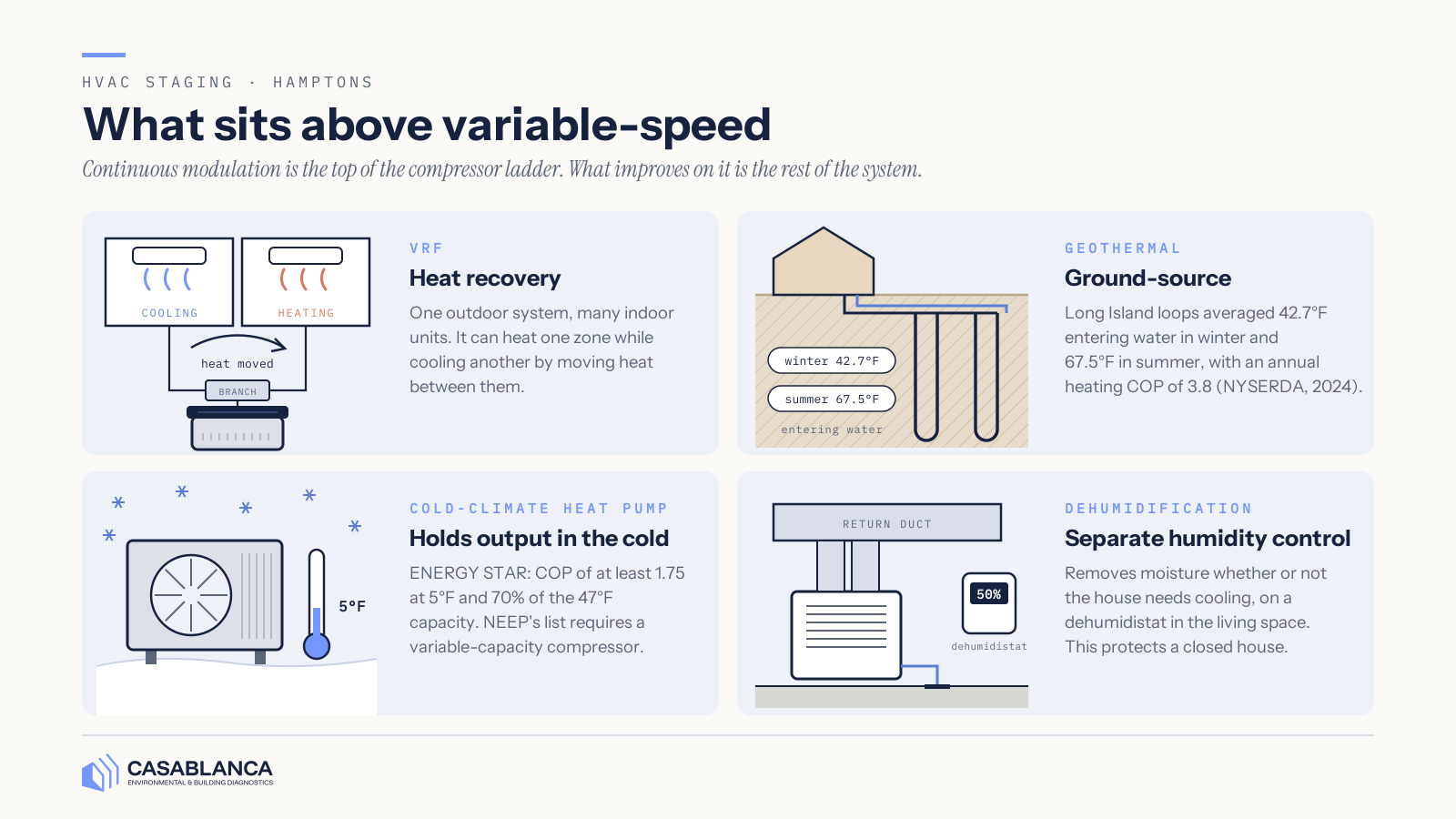
Continuous modulation is the top of the compressor ladder. What improves on it is the rest of the system.
A lower minimum. The bottom of the range differs by model: 25 percent in Trane's description, 40 percent in Carrier's Greenspeed data. On a 3-ton system that is 9,000 versus 14,400 Btu/h, and it decides how many spring and fall hours the unit runs steadily instead of cycling. Ask for the minimum in Btu/h from the manufacturer's expanded performance data, not the nameplate tonnage.
Variable refrigerant flow (VRF). VRF connects variable-speed outdoor equipment to many indoor units. The Department of Energy's EnergyPlus documentation describes systems with "as many as 60 or more indoor units with differing capacities in conjunction with one single outdoor unit," and heat-recovery VRF "can deliver simultaneous heating and cooling to different zones by transferring heat" between them, for example cooling a sunny south room while heating a north one. It fits large houses with many zones. Each indoor unit still has its own minimum, so small rooms need the same sizing care as a ductless head.
Geothermal. A ground-source heat pump uses the same compressor choices, but it exchanges heat with the ground instead of the outdoor air. The Department of Energy states that "a few feet below the earth's surface the ground remains at a relatively constant temperature year-round," in a range of 40 to 70°F, and that relative to air-source heat pumps "they are quieter, more efficient, last longer, need little maintenance." NYSERDA's 2024 field study of ground-source heat pumps on Long Island measured average entering water temperatures of 42.7°F in the heating season and 67.5°F in the cooling season, an average corrected annual heating COP of 3.8, and about 20 percent lower peak demand than cold-climate air-source heat pumps at 10°F. The monitored systems were variable-speed and dual-stage.
Cold-climate heat pumps. ENERGY STAR's cold-climate criteria require a COP of at least 1.75 at 5°F and heating capacity at 5°F of at least 70 percent of the capacity at 47°F. NEEP's cold-climate specification states: "Compressor must be variable capacity." PSEG Long Island's 2026 rebate, $4,000 at the market rate and up to $7,500 for income-qualified households, requires a unit on NEEP's list installed by a participating Home Comfort Partner. On Long Island, the rebate-eligible air-source heat pump is a variable-speed unit.
Separate dehumidification. An air conditioner of any type removes moisture only while it runs to cool. In spring, in fall, and in a closed house, it runs too little. A whole-house dehumidifier controls humidity whether or not the house needs cooling, and Building America guidance states that "a remote dehumidistat in a representative living space location works better than a dehumidistat on the unit." Large houses can use a dedicated outdoor air system that dries ventilation air before it enters. Our setpoint post works through the dehumidifier sizing.
What to ask before you sign
Put these questions to the contractor in writing and keep the answers with the proposal.
The load calculation. A room-by-room Manual J for this house, showing the design temperatures, the infiltration assumption, and the total, sensible, and latent cooling loads.
The equipment selection. A Manual S selection showing the equipment's total, sensible, and latent capacity at those conditions, and its size as a percentage of the Manual J load.
The minimum output. For two-stage, multi-stage, or variable-speed equipment, the lowest output in Btu/h, and how it compares with the house's spring and fall loads.
The controls. Whether full staging or modulation requires the manufacturer's communicating thermostat, and what the system does on a standard thermostat.
The blower. The motor type, the airflow per ton in cooling, and whether the system has a dehumidify setting that lowers airflow.
The matched rating. An AHRI certificate for the exact outdoor unit, indoor coil or air handler, and furnace combination, from the AHRI Directory. The efficiency rating belongs to the combination, not to the outdoor unit alone.
The ducts. Whether the existing ducts were checked against the new airflow, or sized under Manual D.
The refrigerant. Which one the system uses, and whether the contractor services it. Under EPA's Technology Transitions rule, residential system components for refrigerants with a global warming potential above 700 could no longer be manufactured for new systems after January 1, 2025, as summarized by the ICC.
Humidity. For a seasonal house, whether whole-house dehumidification is included or priced separately.
Rebates. For a heat pump, whether the unit is on NEEP's list and the installer is a PSEG Long Island Home Comfort Partner, before the contract is signed.
What we do
We do not sell, install, or service HVAC equipment, so our measurements are not tied to a sale. In the Hamptons and across the East End, we:
log temperature, relative humidity, and dew point room by room during an indoor air quality assessment, so a humidity complaint can be traced to run time, airflow, a fan setting, or a moisture source;
record the system type, age, and condition, the condensate pan and drain, and the visible ductwork during a pre-purchase home inspection;
check a closed house before it reopens with a seasonal maintenance inspection;
use thermal imaging to find sweating supply registers and ducts.
When we find mold, we perform a mold assessment and write the remediation plan. By law we do not perform remediation on any property we assess. Call or text (631) 655-9855, email bayrona@casablancaebd.com, or send us the address and what you are seeing.
Common questions about single-stage, two-stage, and variable-speed AC
Is a variable-speed air conditioner worth it? It is the most efficient and the steadiest of the four types, and it costs the most to buy and to repair. It returns the most where the house spends many hours at part load and the equipment's minimum output sits below those loads. If the proposal does not show a Manual J and the minimum output in Btu/h, the comparison is incomplete.
Does a two-stage AC remove more humidity than a single-stage? At part load, yes. Its low stage, about 65 percent of full output, runs longer cycles, and Trane states that two-stage systems "are more efficient in removing moisture in the air than single-stage systems." Neither removes much moisture when the house needs little cooling.
Why is my house humid when the air conditioner is running? Common causes are short cycles from an oversized or lightly loaded system, the fan set to On, airflow set too high for the coil, and outdoor air leaking in. A data logger that records dew point, read alongside the system's run times, shows which one it is.
Can I put a variable-speed outdoor unit on my existing furnace or air handler? Often not as a variable-speed system. Many lines control and rate the outdoor unit as part of a matched set. Carrier's Greenspeed data states that the "System requires Infinity Control with Greenspeed capability," and Bryant's five stages require a complete Evolution system. Ask for the AHRI certificate for the exact combination.
Should the fan be on Auto or On? Auto, in the cooling season. With the fan on, the blower pushes room air across a wet coil between cycles and returns water to the house.
Does a bigger air conditioner cool better? It reaches the setpoint sooner and removes less moisture per hour, because it runs shorter cycles. New York's codes require equipment to be sized under Manual S from a Manual J load.
Is "inverter" the same as "variable-speed"? Yes. An inverter drive varies the compressor motor's speed, which is what "variable-speed" means when it is used correctly. Some lines sold as variable-speed run a few fixed steps instead.
Hamptons and East End questions
Our Hamptons house is empty Monday through Thursday. Which system should we buy? Size it from a Manual J that reflects how the house is used, choose equipment whose minimum output is low enough for spring and fall, and add whole-house dehumidification on a living-space dehumidistat for the days the house is closed. Whether something controls humidity while nobody is there matters more than the compressor type. The setpoint post covers the settings.
We are replacing oil heat with a heat pump for the PSEG Long Island rebate. Will it be too big for the summer? It can be. The rebate requires sizing at 100 to 120 percent of the whole-house heating load, and on Long Island that is usually more than the cooling load. Ask for the heat pump's minimum cooling output compared with your summer part load, and for a dehumidify setting or a separate dehumidifier.
Our pool house has a ductless unit that keeps the room cold and damp. Is the unit defective? Often it is oversized for the room. A ductless head turns down only so far, and below that it cycles with a coil too warm to dry the air. The fixes are a smaller head matched to the room's Manual J load, a single-zone outdoor unit, or a dehumidifier.
Is geothermal worth it on the East End? It is the most efficient of these options, and it costs more to install than an air-source system because of the wells or loop field. NYSERDA's Long Island study measured an average corrected annual heating COP of 3.8 for the systems it monitored. Whether it pays back depends on the drilling cost for the site and the fuel it replaces, so get a quote that states the loop design and the expected annual energy use.
Sources and further reading
Trane, Fonda, A., What's the Difference: Variable Speed vs. Two-Stage vs. Single-Stage HVAC Systems Explained (June 17, 2026).
Carrier, Infinity Greenspeed 25VNA heat pump product data (copy hosted by Parts Town).
Shirey, D., Henderson, H., and Raustad, R., Florida Solar Energy Center, Understanding the Dehumidification Performance of Air-Conditioning Equipment at Part-Load Conditions (FSEC-CR-1537-05, 2006).
Orr, B., HVAC School, The Ductless Dehumidification Conundrum (February 10, 2020); The Difference Between Variable-Speed and X13 Motors (October 2024).
Bailes, A., Energy Vanguard, This Thermostat Setting Can Cost You Money and Make You Sick (September 7, 2014).
International Code Council, New York requirements for sizing heating, ventilation and air conditioning (HVAC) systems (February 7, 2019).
ENERGY STAR Single-Family New Homes, National HVAC Design Report, Rev. 13 (revised February 1, 2024).
ACCA, Evolving Industry, Revised Standard (Manual S, 2014 edition).
PSEG Long Island, Heat Pump Rebates and Eligibility (2026).
U.S. Department of Energy, EnergyPlus Engineering Reference, Variable Refrigerant Flow Heat Pumps (version 9.6).
U.S. Department of Energy, Energy Saver, Geothermal Heat Pumps.
NYSERDA, Field Monitoring Ground Source Heat Pumps on Long Island (Report 24-04, January 2024).
ENERGY STAR, Air-Source Heat Pumps Key Product Criteria (cold climate).
Rudd, A., Building America, Supplemental Dehumidification in Warm-Humid Climates (Building America Report 1310, July 2013).
International Code Council, Building Safety Journal, An Update on EPA's Technology Transitions Program (December 16, 2024).