
Quick answer: A residential inspection is a visual check of a one-to-four family home for a buyer, done in about 2 to 4 hours by a state-licensed home inspector. A commercial inspection follows ASTM E2018, takes a day or more, often involves engineers, and produces a property condition report with repair cost estimates.
The main difference in a commercial vs. residential inspection is who the report is written for. A home inspection tells a buyer whether the house is sound enough to live in. A commercial inspection tells an investor, lender, or tenant what the building will cost to own and run over the next ten years.
On Long Island, that line gets blurry fast. A Main Street building with a shop downstairs and two apartments upstairs, or a six-unit rental in Patchogue, doesn’t fit neatly into either box. Booking the wrong inspection can leave you with a report your lender won’t accept, or one that skips the rooftop units and fire system entirely.
Key takeaways
New York licenses home inspectors to inspect one-to-four family homes. Larger or mixed-use buildings need a commercial inspection.
Commercial inspections follow ASTM E2018 and end in a property condition report (PCR) with cost estimates.
A home inspection takes hours; a commercial inspection can take days, plus document review.
Commercial reports cover ADA access, fire and life safety, and capital reserves. Home reports don’t.
Environmental testing (mold, asbestos, water) is a separate add-on for both.
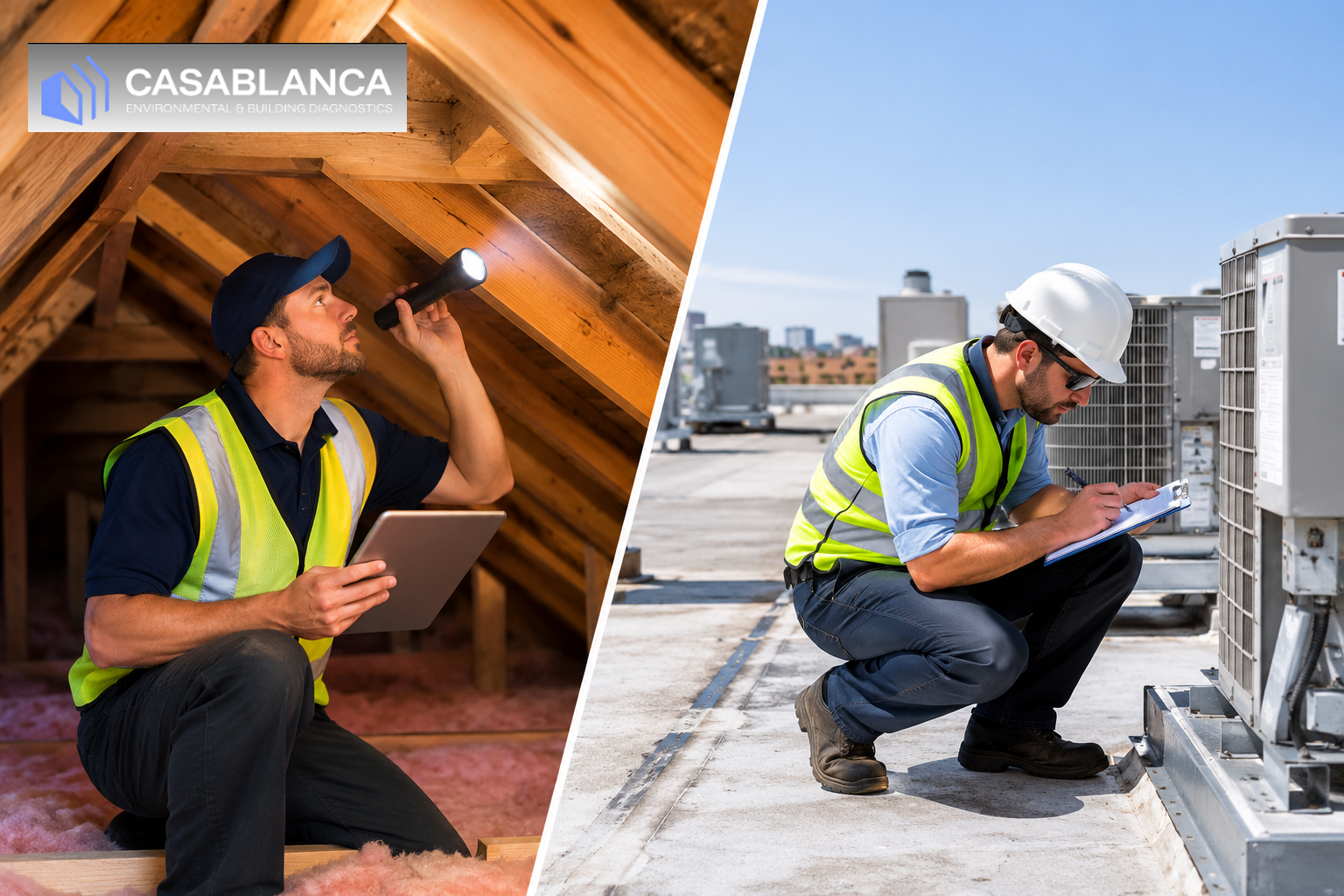
Commercial vs residential inspection at a glance
| Factor | Residential (home) inspection | Commercial property inspection |
|---|---|---|
| Property type | 1 to 4 family homes, condos | Retail, office, industrial, 5+ unit multifamily, mixed-use |
| Standard | NY DOS standards of practice, ASHI or InterNACHI | ASTM E2018 property condition assessment |
| Who inspects | NYS licensed home inspector | Inspector team, often with a PE or architect |
| Time on site | About 2 to 4 hours | A full day or more |
| Report | Defect list with photos | Property condition report with cost tables |
| Who orders it | Home buyer or seller | Investor, lender, tenant, owner |
What is a commercial property inspection?
A property inspection is a walk-through survey of a business or investment building that records the condition of its structure and systems, estimates repair and replacement costs, and flags code or safety issues. Most follow ASTM E2018, the standard for a property condition assessment (PCA).
What a commercial property inspection covers
The inspector looks at the site, structure, building envelope, roof, plumbing, HVAC, electrical, elevators, fire suppression, and accessibility. On a restaurant, that might mean grease traps and kitchen exhaust. On a warehouse, it’s loading docks, slab cracks, and three-phase electrical service. Buyers can also review a commercial building inspection checklist to understand the major components examined during an assessment and identify important areas before purchasing a commercial property.
ASTM E2018 and the property condition assessment
ASTM E2018 sets three parts of a PCA: the walk-through survey, a document review, and interviews with owners or building staff. The findings go into a property condition report.
Who performs commercial inspections?
New York doesn’t issue a separate commercial inspector license. Lenders often want a licensed professional engineer or registered architect to sign off on structural findings. Many teams pair a building inspector with an engineer and, when needed, an environmental assessor.
How long does a commercial inspection take?
A small retail building may take one day on site. A multi-tenant property can take several days, followed by a week or two for document review and the written report. Compare that with a single-family home, which is usually done in a morning.
What does a home inspection cover?
An inspection is a visual, non-invasive check of a house’s major systems and components, written up for a buyer or seller. In New York, it must be done by an inspector licensed by the Department of State.
Systems checked in a standard home inspection
A home inspector checks the roof, attic, foundation, basement or crawlspace, exterior, windows and doors, plumbing, water heater, electrical panel, heating and cooling, and visible insulation. Most also test a sample of outlets, run appliances, and look for signs of past water damage.
Home inspector licensing in New York
New York’s Real Property Law, Article 12-B, licenses home inspectors and limits the license to residential buildings of one to four families. Casablanca’s founder, Bayron Alvarez, holds NYS DOS Home Inspector license #16000145204 and NYS Mold Assessor license #25-671AE-SHMO.
What a home inspection does not include
A standard home inspection won’t test for mold, radon, lead, or asbestos, and it won’t open walls. It also doesn’t check septic or cesspool systems, which matters in Suffolk County, where many homes aren’t on public sewers.
HUD explains why a home inspection is worth ordering, and why an appraisal isn’t a substitute for one, in its buyer guide for your protection.
Commercial inspection vs home inspection: systems and stakes
The gap between a commercial inspection and a home inspection shows up most in the building systems and in what’s riding on the report.
Roofing: low-slope commercial vs pitched residential
Most homes have pitched asphalt shingle roofs. Commercial buildings usually have low-slope roofs covered in TPO, EPDM, or modified bitumen, with rooftop HVAC units, drains, and penetrations that leak if flashing fails. Drone photos help on large roofs, and Bayron holds an FAA Part 107 remote pilot certificate for that work.
HVAC and electrical load
A house usually has one furnace or boiler and a 100 to 200 amp panel. A commercial building can have several rooftop units, a chiller or boiler plant, and three-phase power. The inspector checks age and capacity against how the building is used now.
Fire, life safety, and ADA accessibility
Commercial reports cover sprinklers, fire alarms, exit signs, emergency lighting, and egress. They also note barriers to access under the Americans with Disabilities Act, which applies to public accommodations and commercial facilities but not to private homes. The federal rules are in the 2010 ADA Standards for Accessible Design.
Environmental concerns: asbestos, lead, mold, and radon
Both property types can hide environmental problems. Homes built before 1978 may have lead paint, and buildings built before 1981 are presumed to contain asbestos until tested. Mold from moisture intrusion is common in Long Island basements and coastal properties. Radon is a soil gas, so it’s tested with a short-term kit or monitor, not spotted by eye.
Cost and timeline compared
Commercial inspections cost more because they take longer, involve more specialists, and include detailed cost estimating. On Long Island, residential home inspections typically range from $400 to $900+, while commercial property inspections can range from approximately $700 to $4,000+, depending on building size, complexity, and inspection scope. These are market estimates, not confirmed Casablanca pricing.
What goes into a property condition report?
A property report is the written result of a PCA. It describes each building system, rates its condition, estimates remaining useful life, and lists the cost to fix or replace it.
Tip 1: Review the Building's Maintenance Records
Ask the seller for previous inspection reports, roof maintenance records, HVAC service history, and records of major repairs. Comparing these documents with the inspection findings can help buyers identify recurring problems and anticipate upcoming maintenance expenses.
The core sections of a PCR
Executive summary with the biggest risks and total cost estimates
Site and building description
System-by-system condition findings with photos
Immediate cost table (safety issues and code violations)
Reserve table (replacements expected over 10 to 12 years)
Document review and interview notes
Immediate costs vs reserve costs
Immediate costs are expenses for problems that require prompt attention, such as a failed fire alarm panel $2000 to $10,000, a trip hazard at the entrance $500 to $3,000, or urgent roof repairs $1500 to $8,000. Reserve costs cover major replacements expected in the coming years, such as a commercial roof replacement $8 to $15 per square foot or an HVAC system replacement $5000 to $15,000+ per unit. Buyers use both figures to estimate future expenses, negotiate the purchase price, or request seller credits.
Property condition report vs Phase I ESA
A PCR covers the physical building. A Phase I environmental site assessment covers contamination risk on the land, such as past fuel tanks or dry cleaning use, and follows ASTM E1527 to meet EPA’s All Appropriate Inquiries rule. Commercial lenders often ask for both.
Which inspection does your property need?
Use the building’s size and use to decide, not its look.
Mixed-use buildings
A storefront with apartments above is a commercial property. A home inspector can’t legally cover it under a New York license, so book a commercial inspection that also looks at the residential units.
1- to 4-unit rentals vs 5+ unit multifamily
A two-family or four-family rental gets a standard home inspection. Five units or more usually means a commercial loan, and the lender will expect a commercial inspection and PCR.
Condos, co-ops and leased commercial space
Condo and co-op buyers get a home inspection of the unit, though the board’s reserve study tells you more about the building. Tenants signing a commercial lease should inspect before signing, since many leases make the tenant responsible for HVAC and roof repairs.
Tip 2: Confirm Inspection Requirements Before Booking
Before scheduling an inspection, check with the lender, insurance provider, or property attorney to confirm which inspection standards and reports are required. Some commercial transactions require an ASTM E2018 property condition assessment, while others may also need a Phase I Environmental Site Assessment.
FAQs for Commercial vs Residential Inspection
What are the key differences between residential and commercial properties?
Residential properties are for people to live in; commercial properties earn income through business use or five or more rental units. They differ in zoning, lending, building codes, and lease terms.
What are the three main types of inspections?
For property buyers, the three main types are pre-purchase inspections, pre-listing inspections, and new construction inspections.
What is the biggest red flag in a home inspection?
Water getting in is the biggest red flag. Active leaks, a wet basement, or a stained ceiling can point to roof, foundation, or drainage problems and the mold that follows.
What are two key differences between residential and commercial buildings?
Commercial buildings must meet stricter fire and accessibility codes, including the ADA. They also run heavier systems, like three-phase power and rooftop HVAC units.
What are the 7 main types of inspection processes?
In manufacturing, the term covers stages like first article and pre-shipment checks. In real estate, the seven most common inspections are general home, commercial PCA, roof, mold, radon, water quality, and septic.
What are the four types of inspections?
For buildings, the four common types are pre-purchase, pre-listing, new construction, and seasonal maintenance inspections.
How much does a commercial property inspection cost?
Typically, it costs between $700 and $4,000+, depending on the building's size, type, age, location, and inspection requirements. Smaller commercial properties may cost around $700 to $1,500, while larger or more complex buildings can range from $2000 to $4,000+. Additional services, such as structural engineering reviews, roof assessments, and environmental testing, may increase the total cost. These are general estimates, not confirmed Casablanca pricing.
Can a home inspector inspect a commercial building?
Not under a New York home inspector license, which covers one-to-four family homes. Commercial buildings need an inspector experienced in ASTM E2018 work.
Conclusion
Choosing between a commercial and residential inspection depends on the property’s size, use, building systems, and intended purpose. While residential inspections focus on the visible condition of a home and its essential components, commercial inspections provide a broader assessment of structural conditions, major systems, safety requirements, and future repair expenses. Understanding these differences helps buyers, investors, and property owners make informed decisions before completing a transaction.
For property owners across Long Island, Casablanca Environmental & Building Diagnostics provides residential and commercial inspection services to identify potential concerns and assess building conditions. Whether purchasing a family home, investing in a multifamily property, or evaluating a commercial building, arranging the appropriate inspection can help reduce unexpected expenses and support better property decisions.
Book the right inspection on Long Island
Casablanca Environmental & Building Diagnostics inspects homes and commercial buildings across Suffolk County, from the Hamptons and North Fork to Port Jefferson and Bay Shore, and can add mold, air, and water testing to the same visit. Call 631-655-9855 or email bayrona@casablancaebd.com to book.
Sources
HUD, For Your Protection: Get a Home Inspection: HUD’s buyer guidance on why a home inspection matters and how it differs from an appraisal.
U.S. DOJ, ADA Design Standards: the federal accessibility standards that apply to commercial facilities but not to private homes.
EPA, Brownfields All Appropriate Inquiries: EPA’s rule behind Phase I environmental site assessments in commercial deals.
