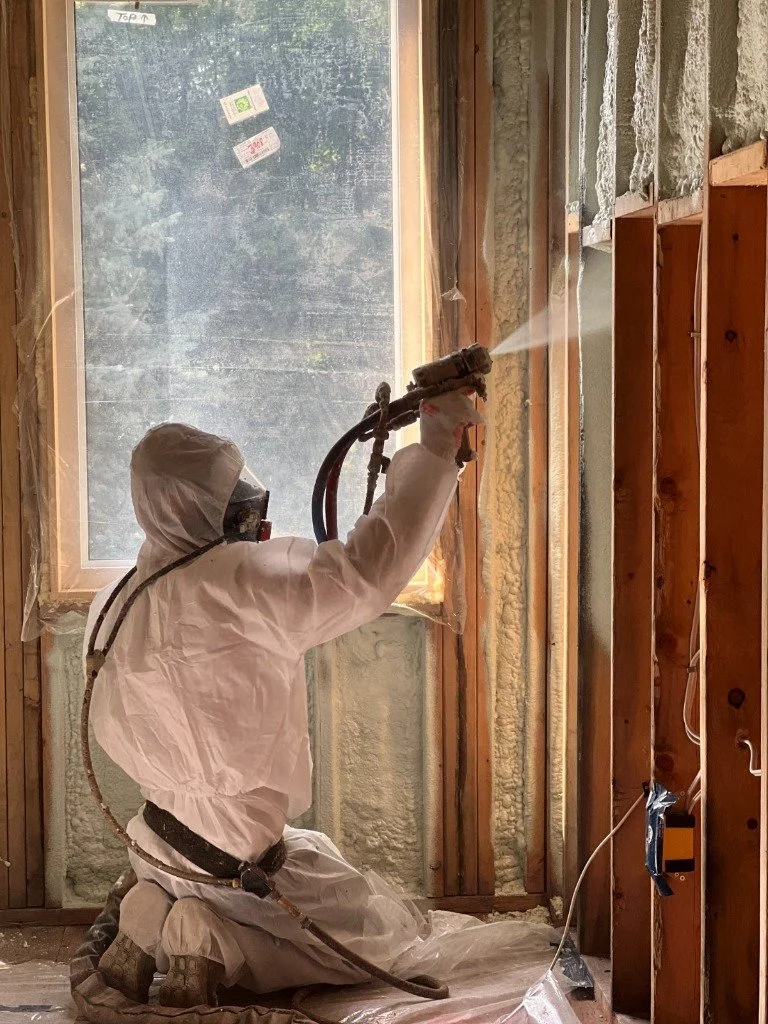
Spray Foam Insulation Odor on the East End: What the Smell Is, When It Means a Bad Install, and What an Air Quality Assessment Can Prove
By Bayron Alvarez, NYS Licensed Mold Assessor (#25-671AE-SHMO) and NYS Licensed Home Inspector (#16000145204) — Casablanca Environmental & Building Diagnostics, Southampton, NYSpray polyurethane foam is in the roof decks, attics and rim joists of many new construction and renovated homes on Long Island. The complaint that follows some of these jobs is consistent: a fishy or sharp chemical odor that was tolerable in March, disappeared when the windows were open, and came back on the first hot week of June, strongest on the second floor. The installer has usually said it will cure out. Sometimes it does. When it doese’t, the owner is living with a continuous chemical source bonded to the framing, and neither an air purifier nor time will remove it.
This article explains what is in the foam, what the odor is, what separates a normal cure from a misapplied installation, why heat makes it worse in a closed home, what an indoor air quality assessment can and cannot measure, and how to specify a foam job so the question never comes up.
Summary
Spray foam is made on site from two liquids that must be mixed in equal proportion at the correct temperature and pressure and applied in limited lifts. The isocyanate side is gone within hours of a proper cure. The odor that persists is the amine catalyst, which is not consumed by the reaction, and the flame retardant TCPP, which NIST reports is present in the foam and emits for years. Both emissions rise steeply with temperature. A normal job has a noticeable odor for days. An odor that lasts weeks, returns every summer, or comes with soft, dark, or shrunken foam indicates an off-ratio or overheated application, and the documented cases that resolved were resolved by removal. An assessment identifies the source, samples the right compounds with the right methods, and produces the evidence a claim against the installer requires.
What is in the foam
Two-component spray foam is formed, in the words of the Center for the Polyurethanes Industry, "via an exothermic (heat-releasing) chemical reaction between approximately equal amounts of polymeric methylene diphenyl diisocyanate (pMDI) and a polyol system." The A side is the isocyanate. The B side is "typically a blend of polyols, catalysts, blowing agent, flame retardant and surfactant." The two liquids are heated and pumped through a gun; New York's own regulation defines the high-pressure process as one using "proportioning pumps at 800-1600 pounds per square inch."
Open-cell foam is water-blown, weighs 0.5 to 0.8 pounds per cubic foot, and provides R-3.6 to R-4.5 per inch. Closed-cell foam weighs 1.8 to 2.3 pounds per cubic foot and provides R-5.8 to R-6.9 per inch. Closed-cell foam sprayed in New York on or after January 1, 2021 may not be blown with HFC-245fa, HFC-134a, or the listed blends under 6 NYCRR Part 494, which in practice means an HFO.
The catalysts are tertiary amines, present at 0.1 to 5 percent of the formulation. The industry's own safe-handling guideline states that "all tertiary amines have a very distinct and strong ammonia-like odor." The flame retardant in most residential foam is tris(1-chloro-2-propyl) phosphate, TCPP. NIST reports that flame retardants are present in reacted polyurethane foam at up to 12 percent by mass, and in the two foams it tested TCPP was about 12 percent of the ingredients used to make the open-cell product and about 8 percent for the closed-cell one.
What the smell is
The Spray Polyurethane Foam Alliance states the normal case directly: "Some SPF materials may give off a noticeable odor for several days after application. These odors, noticed by some people, are usually caused by unreacted amine catalysts, and have been described as smelling like fish, cat urine or fresh latex paint." The isocyanate is not the lingering odor. The same source states that MDI "will degrade into non-hazardous compounds in a few hours when combined with moisture in the air," which is why re-occupancy of the work area "is typically 24 hours." The Connecticut Department of Public Health's technical brief on spray foam gives 24 to 72 hours for a two-component professional product and describes the fishy odor as "one of the hallmark properties of tertiary amines."
The compounds that remain after that window have been measured. In chamber tests for the Consumer Product Safety Commission, NIST found that the amine BDMAEE from open-cell foam peaked three hours after sampling began and remained elevated for 120 hours, decaying exponentially. TCPP did not decay: its concentrations "tended to be constant over time throughout the duration of the experiments," and the study concluded that "occupants may be exposed to measureable concentrations of the flame retardant TCPP at least 1.5 years after application." In a two-year-old house with open-cell foam, NIST measured airborne TCPP at 2.8 micrograms per cubic meter in the basement and 1.5 on the first floor, with none outdoors, and found the concentration "strongly correlated to indoor temperature."
A normal cure, then, produces an amine odor for days. NIST detected TCPP emitting from every foam sample it tested, and it is not an odor complaint; it is a persistent semi-volatile emission that a homeowner cannot smell and a canister sample will not capture.
When the smell means a bad install
The industry's best-practices guidance lists the application variables that determine foam quality: substrate temperature and moisture within the manufacturer's limits, pass thickness and cooling time between passes, wind under 15 miles per hour, and a uniform color "free of cracks, blisters, and delamination." It states that "applying too much SPF per pass, without allowing time for the foam to cool, could cause poor foam quality and create a fire hazard." The product evaluation reports set the numbers: one closed-cell product requires 10 minutes of cooling per inch before the next pass; a low-pressure closed-cell kit is limited to 2 inches per application; open-cell products carry per-pass limits with substrate moisture not exceeding 19 percent and relative humidity under 80 percent. These limits exist because the reaction is exothermic. Foam that gets too hot in a thick lift changes chemically, and a B-rich, off-ratio mix leaves unreacted catalyst in the mass.
NIST tested two foam samples that had come to the CPSC through resident complaints of "severe respiratory irritation, breathing difficulties, dizziness and nausea." It defined non-ideal application as "off-ratio (A-side to B-side) application, low substrate temperature application, and wrong nozzle pressure and temperature." The complaint foams had densities 1.7 and 1.2 times the typical closed-cell value, emission of 1,4-dioxane "was approximately an order of magnitude higher for the non-ideal foam" than for a reference foam, and NIST concluded that "the tested non-ideal SPF may have been misapplied."
The field signs follow from the chemistry. Foam that is soft or gummy in places, that is dark amber or brown in a layer, that has shrunk away from the rafters or cracked, or that has a distinct odor when a core is cut, has not reacted correctly. An odor that persists beyond the first week, and in particular one that returns with warm weather a year later, is the signature of retained catalyst rather than a curing job.
The health record for misapplied foam is documented. A 2014 case series in Environmental Research followed 13 adults from 10 households whose houses were retrofitted with foam under conditions of premature re-occupancy, inadequate ventilation, or improper mixing. All reported fishy odors and developed eye, nose, and throat irritation, cough, and chest tightness; symptoms subsided when they left and recurred when they returned; all eventually vacated, and "the levels of VOCs decreased after SPF was completely removed." During application, the hazard is the isocyanate. EPA's guidance states that "there is no recognized safe level of exposure to isocyanates for sensitized individuals" and that isocyanates "have been reported to be a leading chemical cause of work-related asthma," which is why the house is vacated during spraying and why the installer's ventilation setup is part of the specification.
Why it gets worse in July
NIST reported that both TCPP and BDMAEE concentrations "showed an Arrhenius relationship," meaning they rise exponentially with temperature. In a NIST test house, raising the basement temperature from 21.5°C to 28.5°C, a change of about 13°F, raised the average TCPP concentration 3.4-fold. Foam on the underside of a roof deck in a Southampton or Bridgehampton attic in July is at a temperature far above the room below it, and in an unvented attic there is no ventilation air to dilute what it releases.
The seasonal house makes the pattern worse. A house foamed in March, closed with the air conditioning off or set high through June, and reopened for the season has spent weeks accumulating emissions at elevated temperature with a low air change rate. The odor the owner reports on arrival is the concentration that built up while the house was closed. The same installation in an occupied house with the windows open in spring may never generate a complaint.
This is also why testing on a cool morning tells you little. The measurement has to be taken when the foam is warm.
What an indoor air quality assessment measures
The source comes first. A tighter envelope concentrates odors from other sources, so the first job is to establish that the foam is the source: depressurize the room with a fan and trace air paths at the attic hatch, recessed lights, and top-plate penetrations; compare the odor at the foam surface with the odor in the room; and cut cores from several locations, because odor varies with lift thickness and spray sequence. A core from a misapplied job has a strong odor on its own.
Temperature is the controlling variable. Readings are taken at the hottest part of a summer afternoon with the foam-surface temperature logged from the thermal camera, and repeated on a cool morning. The difference between the two is what the claim turns on.
TVOC is a screen, not a result. A photoionization detector reports a total against a reference gas; it cannot identify an amine or a flame retardant, it under-reads semi-volatile compounds, and EPA states that "no federally enforceable standards have been set for VOCs in non-industrial settings." The reading is used for room-to-room and hot-versus-cool comparison and for locating the strongest source. The quantitative results come from the laboratory.
The laboratory methods have to match the chemistry. The isocyanate is gone within hours of a proper cure, so sampling for MDI weeks later is looking for the wrong compound. NIST measured the amine catalysts and TCPP on sorbent tubes analyzed by thermal desorption GC/MS, the approach EPA Method TO-17 describes; a TO-15 canister, the standard method for volatile compounds, does not capture TCPP and is not the method for the amines. TO-15 does capture 1,4-dioxane and the blowing agents, and DNPH sampling captures the aldehydes. An assessment for a foam complaint specifies all three and confirms with the laboratory which catalysts it can report.
The bulk-sample chamber test is the claim-grade evidence. ASTM D8142 is the micro-chamber test method, and it states that it "can also be used to measure the emissions from SPF insulation samples that are collected from building sites where the insulation has already been applied." The method lists investigation of odor complaints after product application among its potential uses, while noting that the specific details of odor investigations are outside its scope. The laboratory holds the cores at an elevated temperature and reports the emitted compounds at 2 and 24 hours. That result, beside the installer's own data sheet limits for lift thickness and substrate temperature, is the document a claim rests on. The file also holds the product name and lot numbers, the safety and technical data sheets, the evaluation report number, the date and weather of the spray, the ventilation used, the re-occupancy time given, and the installer's Suffolk County home improvement license.
Why air purifiers, foggers, and ozone do not fix it
EPA's position on indoor pollutants applies without modification: "the most effective ways to improve your indoor air are to reduce or remove the sources of pollutants and to ventilate with clean outdoor air." Its technical summary on residential air cleaners states that "all adsorbents have limited capacities and thus require frequent maintenance" and that that "effectiveness of many consumer-grade systems with small amounts of activated carbon is unknown." A carbon filter removes mass from the air until it saturates; a roof deck holding hundreds of pounds of flame-retarded foam replenishes the air continuously, faster on every hot day. The device treats a room's air; the source is the building.
Ozone generators make the problem worse. EPA states that "NO agency of the federal government has approved these devices for use in occupied spaces," and that where ozone reacts with indoor chemicals "the reaction can form a variety of harmful or irritating by-products." Odor-neutralizing foggers add their own volatile compounds and mask the diagnostic odor before it can be sampled. Neither should be used before an assessment, and neither addresses the foam.
The fix
In the documented cases, what resolved the exposure was removal. The households in the 2014 case series saw indoor VOC levels fall after the foam was completely removed, and an indoor air investigator who has handled these complaints for over ten years reports a case in which the owner replaced the roof structure to end the odor. The industry's removal guidance describes the work: open-cell foam comes off with serrated trowels and wire brushes, closed-cell with saws and scrapers, and "cured SPF may, however, present a respirable dust hazard during removal," so respirators, coveralls, and bagged disposal are specified.
Encapsulation is the partial measure. Covering the foam with foil-faced gypsum board reduces the emission reaching the room; it does not remove the source, and it has no published performance standard. Extended mechanical ventilation, an exhaust fan or an energy recovery ventilator running continuously, lowers the concentration as the air change rate rises, and the industry describes it as a step that may be helpful while the decision is made. Opening windows is not a ventilation plan for a house that was foamed to be tight. The choice between removal and encapsulation depends on the chamber results, the extent of the misapplication, and the sensitivity of the occupants, not on the installer's assurance that the odor will fade.
The code facts that come with foam
Foam plastic is regulated under Section R316 of the 2020 Residential Code of New York State. Inside the house, foam must be separated from the living space by a thermal barrier of half-inch gypsum board or an approved equivalent; in an attic or crawl space entered only for service of utilities, an ignition barrier such as 1.5-inch mineral fiber or quarter-inch wood structural panel may be used instead. Products evaluated for use without a prescribed barrier may be installed only up to the thickness in their evaluation report, and those thicknesses assume properly reacted foam. Air-impermeable foam on the underside of the roof deck is one of the compliance paths for an unvented attic under Section R806.5, which is why it is specified so often here. New York adopted the 2025 Uniform Code effective December 31, 2025; houses permitted before that date were built under the 2020 edition cited here. A misapplied foam is therefore two problems: an emission source, and a fire-code assembly whose thickness limits and barriers were engineered for foam that cured correctly.
How to specify a foam job so the question never comes up
The installer holds a current Suffolk County home improvement contractor license, verifiable through the county's license search, and the crew has completed the industry's health and safety training; the Spray Polyurethane Foam Alliance's Professional Certification Program is the credential to ask for. The contract names the product, attaches its evaluation report and technical data sheet, and states the maximum lift thickness, the substrate and chemical temperature windows, and the maximum installed thickness. The installer logs substrate temperature and moisture before spraying. Containment ventilation is specified in air changes per hour with exhaust exceeding supply; the industry's worked example is 30 air changes per hour. The house is vacated during the work and the re-occupancy time is in writing. Cores are cut and retained from three locations, and for an unvented attic the thermal or ignition barrier is part of the scope. An owner with those documents has a specification. A proposal that says only "spray foam, R-value per code" is not one.
If a foamed house has an odor that has lasted more than a few weeks, that returns with warm weather, or that coincides with irritation symptoms, an indoor air quality assessment documents the source, the temperature dependence, and the compounds involved, with laboratory methods chosen for foam chemistry and core samples prepared for chamber testing. Call or text (631) 655-9855 or email bayrona@casablancaebd.com to schedule.
Common questions about spray foam odor
Is the smell dangerous or only unpleasant?
The amine odor is an irritant at the concentrations that produce a strong smell; the industry's own guideline lists eye, nose, throat, and lung irritation and blurred vision with a halo effect around lights. The documented case series of misapplied installations reported respiratory and neurological symptoms that resolved on leaving the house. There is no residential exposure standard for these compounds, which is why source identification matters more than a number.
How long should a new foam job smell?
Days, according to the industry. Many manufacturers suggest 24 hours when the recommended ventilation is used, and the Connecticut health department's guidance is 24 to 72 hours for a professional two-component product. An odor that lasts weeks or returns in summer is not a curing job.
Will it cure out if I wait a year?
The amine emission decays over time; the TCPP emission does not, and NIST measured it in a house two years after installation. Misapplied foam holds unreacted material that diffuses out with every warm day.
Can I cover it with drywall?
Code already requires a thermal or ignition barrier over foam in most locations, and foil-faced gypsum board reduces what reaches the room. It is a partial measure without a published performance standard, and it does not address a fire-code assembly built with defective foam.
What does testing prove?
A TVOC screen shows where and when the concentration is highest; sorbent-tube and canister samples identify the compounds; a chamber test on cut cores shows what the installed foam itself emits at temperature. The chamber test and the installer's own data sheet limits are what support a claim. Laboratory fees are itemized separately from the assessment fee.
East End questions
The house was foamed in March. We arrived Memorial Day weekend to a fishy smell on the second floor. Why now?
The foam under the roof deck has been heating up since May in a closed house with a low air change rate, and both catalyst and flame retardant emissions rise exponentially with temperature. The concentration you walked into is what accumulated while the house was shut. Ventilate mechanically and have the source confirmed before the installer's explanation becomes the record.
Our unvented attic in Bridgehampton has closed-cell foam on the roof deck. Does it need an ignition barrier, and is the thickness legal?
It depends on the product's evaluation report. Some products are evaluated for use at the roof deck without a prescribed barrier up to a stated thickness; beyond that thickness, or for products without that evaluation, the barrier in Section R316.5.3 applies. An assessment measures the installed thickness and compares it with the report.
Was our closed-cell foam HFC-blown or HFO-blown, and does it matter?
Closed-cell foam sprayed in New York on or after January 1, 2021 may not use HFC-245fa, HFC-134a, or the listed blends under 6 NYCRR Part 494, which in practice means an HFO. Open-cell foam is water-blown and was never affected. The blowing agent is not the odor, but it is a fingerprint in the laboratory result that dates the installation and identifies the product type.
The installer will not return calls. Where do I go in Suffolk County?
Suffolk County Consumer Affairs, (631) 853-4600, for license verification and a complaint. Assemble the documentation first; a complaint with chamber results and the product's own data sheet limits is a different filing from a complaint about a smell.
Sources and further reading
• Center for the Polyurethanes Industry (American Chemistry Council), SPF Insulation Basics; Product Stewardship Workbook (2016); Polyurethane Amine Catalysts Safe Handling Guidelines; Guidance on Best Practices for the Installation of SPF; Guidance on Ventilation During Installation of Interior Applications of High-Pressure SPF (2016); Information Sheet on Reentry and Reoccupancy Times; Guidance on the Removal and Disposal of High-Pressure SPF Insulation (2016).
• Spray Polyurethane Foam Alliance, Frequently Asked Questions and Professional Certification Program.
• Connecticut Department of Public Health, Technical Brief: Spray Polyurethane Foam (December 2010).
• U.S. EPA (archived Safer Choice pages), Health Concerns about Spray Polyurethane Foam; Vacate and Safe Re-entry Time; SPF Product Types; Ventilation guidance for SPF; Ozone Generators That Are Sold as Air Cleaners.
• NIST, Poppendieck, D., et al., Characterization of Emissions from Spray Polyurethane Foam (for CPSC, 2014); Flame Retardant Emissions from Spray Polyurethane Foam Insulation; Measuring Flame Retardant Emissions from Spray Polyurethane Foam in a Home (2015); NISTIR 8131, Characterization of Emissions from a Non-Ideal Spray Polyurethane Foam Sample (2016); Lessons Learned in Emissions Testing of SPF (2016).
• Huang, Y.C., and Tsuang, W., "Health effects associated with faulty application of spray polyurethane foam in residential homes," Environmental Research 134 (2014).
• NIOSH, Pocket Guide: Methylene bisphenyl isocyanate; OSHA, Isocyanates.
• ASTM, D7859-13 Standard Practice for Spraying, Sampling, Packaging, and Test Specimen Preparation of SPF Insulation for Emissions Testing; D8142-17 Standard Test Method for Determining Chemical Emissions from SPF Insulation using Micro-Scale Environmental Test Chambers.
• Berkeley Analytical, Spray polyurethane foam emissions testing.
• U.S. EPA, Compendium Method TO-15 and Method TO-17; Volatile Organic Compounds' Impact on Indoor Air Quality; Air Cleaners and Air Filters in the Home; Residential Air Cleaners: A Technical Summary, 3rd ed. (2018).
• May Indoor Air Investigations, Case studies of building odors; May, J.C., "Concerns about spray polyurethane foam insulation," Healthy Indoors (2021).
• New York State DEC, 6 NYCRR Part 494, Hydrofluorocarbon Standards and Reporting and Part 494 fact sheet (2025); U.S. EPA, 40 CFR 84.54, Restrictions on the use of HFCs in foam; EPA SNAP, Substitutes in rigid polyurethane spray foam.
• ICC Evaluation Service reports (examples of product application limits): ESR-2642, ESR-3228, ESR-5254, ESR-5499.
• 2020 Residential Code of New York State, Sections R316 (Foam Plastic) and R806.5 (Unvented attic and unvented enclosed rafter assemblies), at codes.iccsafe.org; NYS Department of State, Notice of Adoption of the 2025 Uniform Code.
• Building Science Corporation, Lstiburek, J., BSD-102: Understanding Attic Ventilation.
Suffolk County Department of Labor, Licensing and Consumer Affairs, license search and consumer complaints