
How Much Does a Mold Inspection Cost in Suffolk County, NY? (2026 Guide)
By Bayron Alvarez, NYS Licensed Mold Assessor (#25-671AE-SHMO) and NYS Licensed Home Inspector (#16000145204) — Casablanca Environmental & Building Diagnostics, Southampton, NY. Updated September 2026.The market rate for a mold inspection in Suffolk County is $300 to $800. Angi's 2026 national data puts the average at $671, in a range of $303 to $1,045. Casablanca Environmental & Building Diagnostics charges $1,200 to $2,500 for a mold assessment and $750 to $1,200 or more for post-remediation verification. This guide explains what we charge, what the market-rate inspection typically includes, how we believe a mold assessment should be performed, and what the difference buys a homeowner once remediation starts.
A mold assessment is a building science investigation that ends in a written report. The mold is the symptom; the moisture is the cause; the report is the document the remediation is priced from, performed to, and verified against. The price reflects the time it takes to do all three properly.
What we charge in 2026
These figures are drawn from the assessments we quoted on the East End between April and September 2026. Every assessment is quoted per property after a phone intake, and nearly all residential work falls within these ranges.
Targeted mold assessment (one area or one reported problem): $1,200 to $1,750. Typically 3 to 5 air samples and 1 to 2 surface samples.
Whole-house mold assessment: $1,750 to $2,250. Typically 9 air samples and 3 surface samples across all levels, including the basement or crawl space and the attic where accessible.
Large or multi-structure properties: $2,250 to $2,500 and up. Main house plus pool house or guest house, or houses that require 10 to 12 or more air samples.
Accessory structure only (pool house, guest cottage, garage apartment): $1,650 to $1,850.
Post-remediation verification (PRV): $750 to $1,200 and up, depending on the complexity of the project: the number of remediated areas and containments, the number of clearance samples, and whether more than one structure is involved.
Laboratory analysis by EMSL Analytical is covered in the assessment price. Payment terms are the same on every job: 50% deposit to schedule, the remaining 50% due before the report is released, and the report and supporting documents delivered by Google Drive link after final payment. The on-site portion takes approximately three to four hours. For what the visit itself involves, see What Happens During a Professional Mold Assessment.
What the market-rate mold inspection usually includes
At $300 to $800 the scope is typically a visual walk-through, one to three samples, the laboratory report, and a short written protocol for the remediation contractor. What is usually missing is the work around it: a moisture investigation beyond a meter reading at the visible growth, sampling sized to the house with outdoor controls, calibration records for the instruments, a cost estimate to compare bids against, and any involvement once the report is sent. Some of these inspections are performed by licensed assessors and are fairly priced for that scope. Many are add-ons to a home inspection, or a visit from a remediation company that intends to quote the remediation.
Two points of law apply. New York State Labor Law Article 32 makes it unlawful to perform mold assessment, or to advertise as a mold assessment contractor, without a license from the Department of Labor, and the license can be checked on the Department's search tool. Article 32 also prohibits the same company from performing both the assessment and the remediation on the same property. A remediation contractor's inspection cannot be the independent assessment the law requires, and it cannot produce the remediation plan or the post-remediation clearance.
The practical problem with the low-priced inspection is not that it is wrong. It is that it answers the first question, whether there is mold and roughly where, and leaves the owner to manage what follows: identifying the moisture source, judging whether the protocol addresses that source or only the surface, evaluating the contractor's quote, handling changed conditions during the work, and confirming the work was done. Those are the parts of the process where owners get hurt, and they are the parts a proper assessment is priced to cover.
How a mold assessment should be performed
This is our standard for every assessment. It is also what we recommend an owner ask any environmental company to describe before hiring them.
Start with the moisture, not the mold. Mold grows where a material has stayed wet, and every East End house has a reason: a vented crawl space under an air-conditioned floor, a basement wall with no drainage, an attic with a bathroom fan venting into it, a plumbing leak, a humidifier, a house closed up for the winter. The assessment has to identify the mechanism, because a remediation that cleans the surface and leaves the mechanism in place produces the same growth in one to three years.
Identifying the mechanism is a building science problem, not a mold problem, and it is where our background matters most. Our assessments are performed by a NYS Licensed Mold Assessor who is also a NYS Licensed Home Inspector, with years in high-end residential and commercial construction on the East End before licensing as an assessor. That experience is the difference between reading a moisture meter and knowing why the reading is what it is: how the assemblies in these houses are built, where water gets in and where vapor gets trapped, how a wall or a floor dries and what stops it from drying, and how the HVAC and dehumidification equipment interacts with the building envelope. On site that means moisture readings, thermal imaging, and temperature, relative humidity, and dew point readings inside and out, interpreted against the construction of the house rather than in isolation. The report states the moisture driver, the correction, and the type of contractor who should perform it, at a level of detail a builder can work from.
Sample by plan, against outdoor controls. The number and placement of samples are decided before the visit and sized to the house: the complaint area, representative finished spaces, unfinished basement or crawl space and mechanical areas, the attic where accessible, and two simultaneous outdoor control samples. Surface samples target visible growth to confirm and identify it. All samples are analyzed by EMSL Analytical, an accredited laboratory (AIHA-LAP EMLAP for mold analysis, with New York State DOH ELAP accreditation), and every indoor result is interpreted relative to the outdoor controls and the building conditions. There are no regulatory exposure limits for airborne mold; a raw count means nothing on its own. What matters is whether the indoor fungal types and levels are consistent with the outdoor background or indicate indoor amplification, and which areas of the house fall into Condition 1, 2, or 3 under IICRC S520.
Use calibrated, documented instruments. Sampling pumps are flow-calibrated for each sampling event. The direct-read instruments, including the IAQ monitor used at every sampling location, are calibrated and documented on an annual schedule, and calibration records are kept with the project file and available on request. Laboratory samples travel under chain of custody. If a company cannot produce calibration records for the pump that collected the air samples, the sample volumes are unverified and the results are open to challenge.
Document the building. Photographs of every area and sampling location, moisture and ambient readings, indoor air quality parameters recorded at each sampling location with a TSI Q-Trak XP (temperature, relative humidity, carbon dioxide, carbon monoxide, particulate counts, total VOCs, and formaldehyde, reported alongside the laboratory results), and, at the assessor's discretion, Matterport 3D documentation of the areas of concern so that there is a walkable record of the space as it was found.
Write the report as the working document for the job. Our Mold Assessment Report contains an executive summary, the purpose and scope, the sampling locations, the laboratory results in full, findings and a condition classification for each assessed area, conclusions, a remediation plan for each Condition 3 area, a good-faith remediation cost estimate, the general remediation requirements and work standards, the post-remediation verification criteria, limitations, and the reference standards. It is written so that a licensed remediation contractor can price and perform the work from it, an insurer or attorney can rely on it, and the assessor can verify against it afterward.

3D documentation. A Matterport camera is set up at the start of the assessment so the areas of concern are recorded as they were found, while the second assessor logs conditions on a tablet. Full-face respirators, coveralls, and nitrile gloves under work gloves are standard PPE.

Air sampling. A spore-trap cassette on a flow-calibrated pump, mounted at breathing height, collects a 75-liter sample at a planned location. Sample ID, location, and ambient conditions are recorded at the time of collection.

Sample handling. Each sample is labeled, checked, and sealed before shipment under chain of custody to EMSL Analytical, an accredited laboratory, so every result in the report traces to a specific location and time.
How the report protects the owner during remediation
The remediation plan and work standards in the report function as the scope of work for the remediation contractor, and we have the contractor sign it before work begins. From that point the contractor is working to the assessor's protocol, not to its own proposal. The protocol sets the objective (return each area to Condition 1), the containment and demolition requirements under IICRC S520, the rules for antimicrobials and coatings (EPA-registered for the use and applied per label), worker protection, waste handling and disposal, the pre-clearance shutdown of air scrubbers and dehumidifiers, and the occupant notification and signage that Article 32 requires. It also requires that any mold found outside the documented scope be reported to us, which is how change orders get reviewed by the assessor rather than presented to the owner as a surprise.
The good-faith cost estimate in the report gives the owner a benchmark before any contractor quotes the work. Remediation bids on the East End vary widely for the same scope, and an owner with an independent estimate in hand is in a different negotiating position than one without.
During remediation we remain available to the owner and the contractor by phone and email for questions, review of changed conditions and change orders against the report, and scheduling of the clearance. That support is part of the assessment engagement. A site visit during the work, if one is needed to look at a changed condition, is scheduled and billed separately.
Post-remediation verification is its own engagement, priced at $750 to $1,200 and up as listed above. After remediation and drying, we return for the PRV: visual clearance, moisture clearance, and clearance air sampling in each remediated area against simultaneous outdoor controls, with a written PRV report. Only a licensed NYS Mold Assessor can issue a written passed clearance, and under Article 32 it cannot be the contractor who did the work.
The support between the report and the clearance is the part of the process the market-rate inspection does not include, and it is where much of the price difference goes.
Why building science expertise belongs in the price
A remediation contractor removes contaminated material and cleans. That is the contractor's job, and a good one does it well. What the contractor is not hired to do is diagnose why the material got wet or specify the fix. If nobody in the process does that, the owner pays for remediation, the moisture driver stays in place, and the growth returns.
The most common examples we see on the East End are vented crawl spaces with fiberglass batts under air-conditioned floors, basements with hydrostatic pressure and no drainage, houses held at low cooling setpoints while unoccupied, bathroom exhaust terminating in attics, and finished basements with polyethylene vapor barriers on the wrong side of the wall. Each has a specific correction, and the correction is usually not something the remediation contractor performs. Our reports name the driver, state the correction, and identify the type of contractor who should perform it, and we remain available to review that contractor's proposal against the report. Maintaining interior relative humidity below 60% is our standing recommendation in every report, because it is the single condition most likely to prevent recurrence.
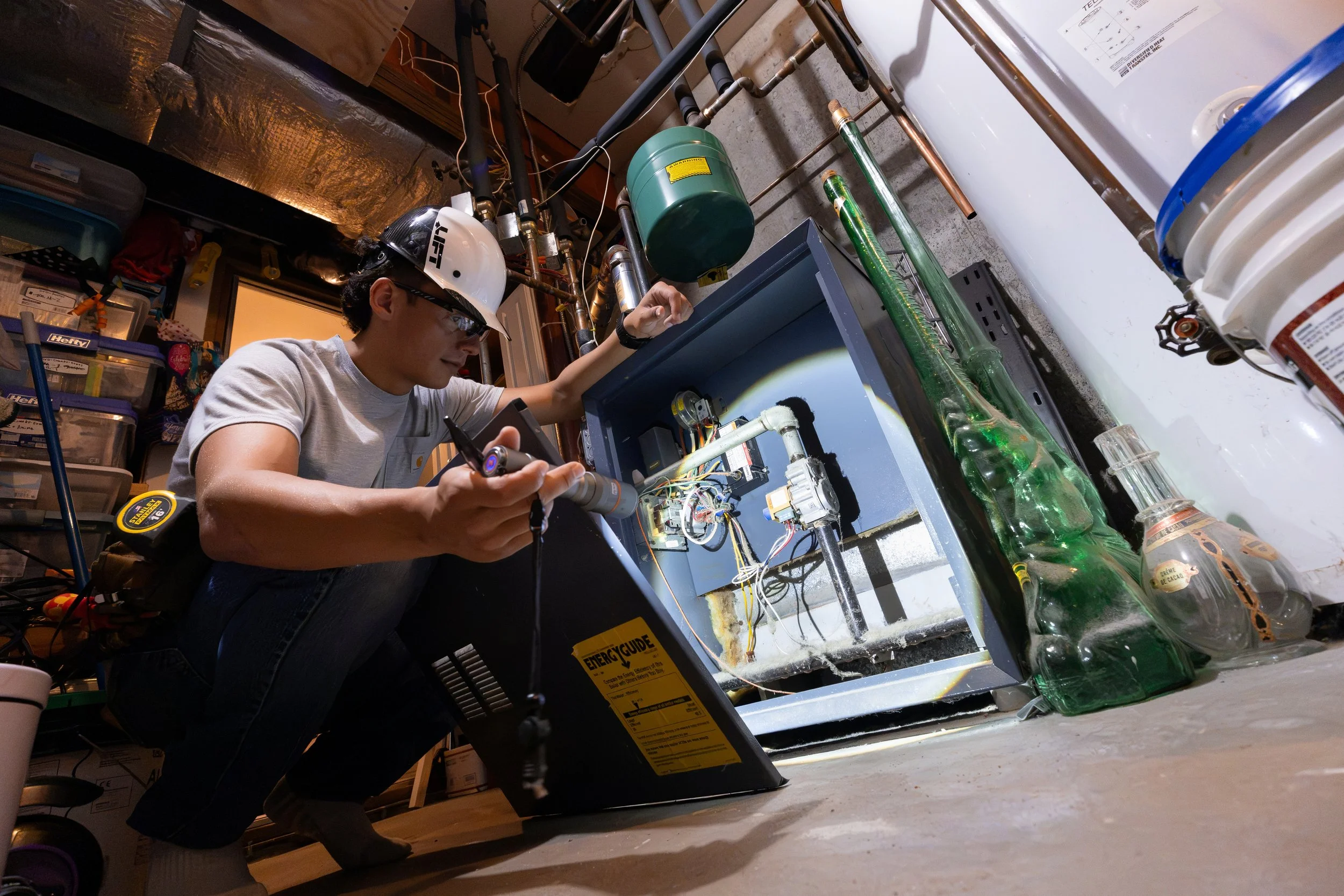
The mechanical room is part of the moisture investigation. The boiler, water heater, piping, and condensate lines are checked for leaks, corrosion, and condensation on cold lines, because mechanical equipment is one of the most common moisture sources in an East End basement.
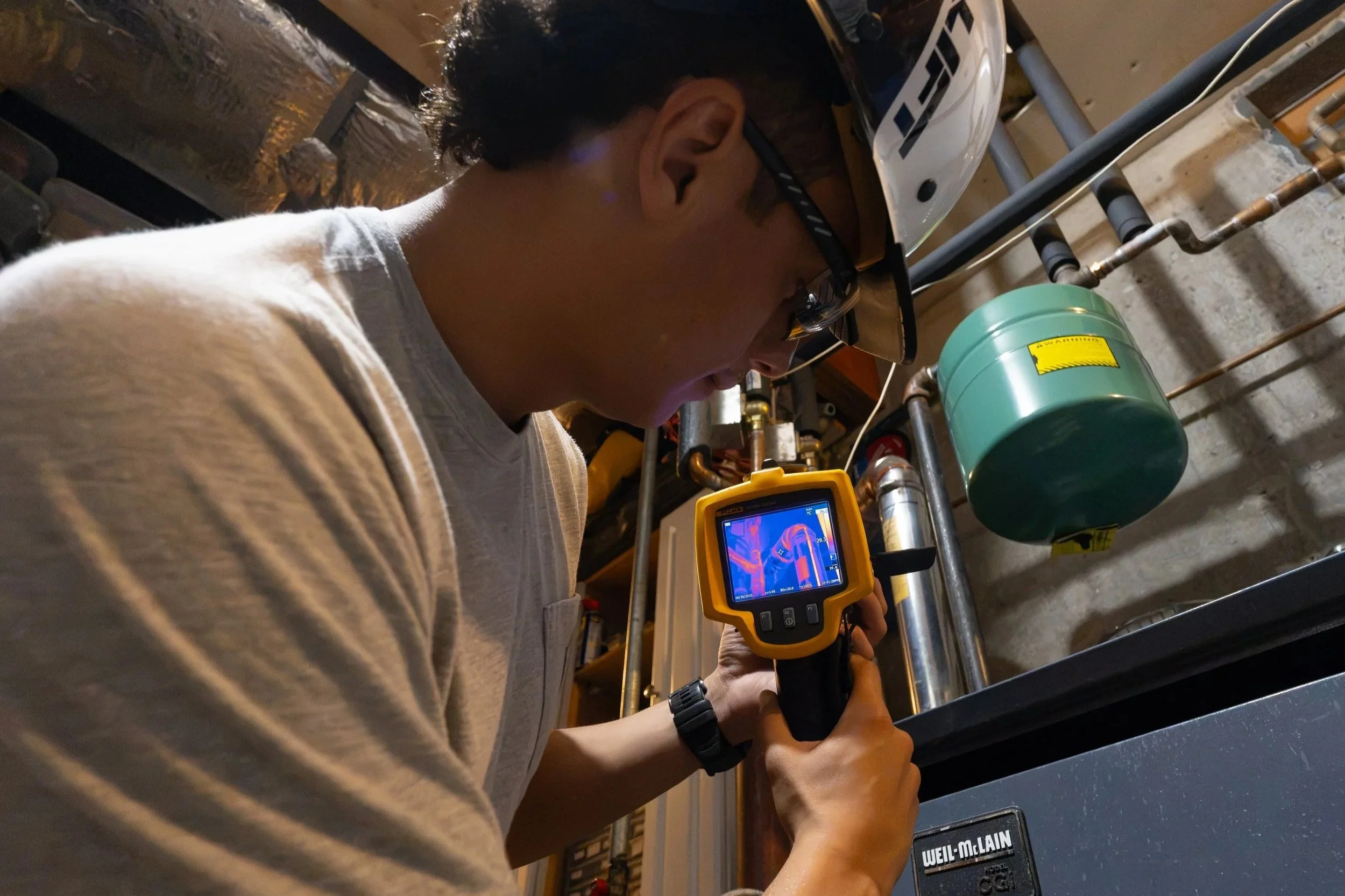
Thermal imaging. An infrared camera shows surface temperature differences on piping, walls, and floors; surfaces below the dew point and the evaporative cooling of wet materials show up before anything is visible.
How to compare environmental companies
When quotes differ by a thousand dollars, compare them on these points before comparing totals:
The mold assessor license number, verified on the NYS Department of Labor search tool.
Whether the company also performs remediation. If it does, it cannot legally assess and remediate your property.
How the company will identify the moisture source, and whether the report will state the correction. Ask what building science qualifications the assessor holds beyond the mold license.
Instrument calibration records for the sampling pumps and direct-read instruments.
The sampling plan: number of air and surface samples, outdoor controls, and the name of the laboratory.
What the report contains, and whether the remediation plan is written as a scope the contractor will sign.
Whether the report includes a remediation cost estimate to compare bids against.
What support is provided between the report and the clearance: who answers the contractor's questions, who reviews changed conditions, and who schedules the PRV.
The PRV criteria and price, stated up front.
Turnaround and payment terms.
A $400 inspection and a $1,750 assessment are both available in Suffolk County. The question is which one still has a role when the contractor is standing in the basement asking what to remove.
Does homeowners insurance cover a mold assessment?
Sometimes, and only in specific circumstances. Most policies cover mold only when it results from a covered sudden loss, such as a burst pipe, and many cap mold-related coverage at a fixed dollar amount. Assessments requested because of long-term humidity, a vented crawl space, or a chronic leak are typically not covered. If a claim is possible, the independent assessment report with laboratory results and moisture documentation is what the adjuster will ask for. Confirm coverage with your carrier before scheduling; we do not bill insurers directly.
Scheduling and sample accuracy
The on-site assessment takes approximately three to four hours. Samples are shipped to EMSL Analytical once the signed assessment agreement and deposit are received; the laboratory runs a 24-hour turnaround on receipt, and the report follows the results.
Sampling results depend on the house being in normal closed conditions. Beginning two days before the assessment, windows and exterior doors should stay closed, the house should not be cleaned or vacuumed, and, when a specific area is being sampled, the air conditioning serving that area should be off if possible. A freshly cleaned house with the windows open produces results that understate the indoor condition.
To schedule a mold assessment or post-remediation verification on the East End, call or text (631) 655-9855 or email bayrona@casablancaebd.com. Casablanca Environmental & Building Diagnostics performs assessments only and does not perform remediation.
Common questions about mold inspection cost
Why is your mold inspection more expensive than the others I called?
Because it includes the moisture investigation, a sampling plan with outdoor controls, calibrated instruments with records, a report that serves as the contractor's signed scope of work, a remediation cost estimate, support during remediation, and the clearance criteria the PRV will be measured against. The market-rate inspection includes a walk-through, a few samples, a lab report, and a short protocol. Both are called a mold inspection.
What do I get for $1,750 that I do not get for $400?
Nine air samples and three surface samples analyzed by EMSL against two outdoor controls; moisture, thermal, and ambient documentation of the cause; indoor air quality readings at each sampling location; a condition classification for each area; a remediation plan and work standards a licensed contractor signs; a cost estimate for the remediation; and an assessor who remains available by phone and email through the remediation. The PRV is a separate engagement.
Are laboratory fees included?
Yes. Laboratory analysis by EMSL Analytical is covered in the assessment and PRV prices.
How long until I have results?
The site visit takes three to four hours. Samples go to the laboratory once the deposit and signed agreement are in, the laboratory turns them around in 24 hours after receipt, and the report is issued after the balance is paid.
Do you offer free inspections?
No. We do not perform remediation, so there is no remediation sale to offset a free inspection. The assessment is the service, and the report is the product.
Can I use a DIY mold test kit first?
You can, but the result will not change what happens next. Retail kits have no outdoor control, no chain of custody, and no interpretation, and a positive result is expected in any house because mold spores are present everywhere. If there is visible growth, a persistent odor, or a known moisture problem, the assessment is the next step either way.
East End questions
Is pricing different in Southampton, East Hampton, or on the North Fork? No. The price is set by scope: the size of the property, the number of structures, and the number of samples required. The ranges above include properties in Westhampton Beach, Hampton Bays, Southampton, Sag Harbor, Bridgehampton, East Hampton, Amagansett, Montauk, Shelter Island, and the North Fork.
How are pool houses and guest houses priced? As their own scope. An accessory structure assessed on its own runs $1,650 to $1,850. A main house and an accessory structure assessed together fall in the large-property range, $2,250 and up, because each building needs its own sampling locations and its own section of the report.
The seller's remediation company says the house has already been "cleared." Do I still need an assessment? Yes, if the clearance came from the contractor who did the work. Under Article 32 the post-remediation assessment must be performed by an independent licensed assessor. Ask for the PRV report and the assessor's license number. If they do not exist, the remediation has not been verified.
We only use the house in summer. When should an assessment be scheduled? For a house that is closed from fall to spring, the most useful timing is either just before the season, so problems are found before the house is occupied, or in July and August, when humidity-driven conditions in crawl spaces and basements are at their worst and sampling captures them. The prep conditions above apply either way.
Sources and further reading
New York State Department of Labor, Mold Program (Labor Law Article 32), including the licensed mold contractor search tool.
New York State Senate, Labor Law Article 32: Licensing of Mold Inspection, Assessment and Remediation Specialists and Minimum Work Standards.
EMSL Analytical, Inc., laboratory partner for CEBD sampling (AIHA-LAP EMLAP accredited for mold analysis; NYS DOH ELAP accredited).
